
Lake Superior College 2025 Annual Security Report for Calendar Year 2024
With Crime Statistics for 2022, 2023, and 2024
- Report Introduction
- Geography
- Statistics
- Hate Crimes
- Emergency Response and Evacuation Procedures
- Campus Security Policies
- Daily Crime Log
- Violence Against Women Act (VAWA) Policies and Programmatic Procedures
- Drug and Alcohol Policies
- Firearms Policy
- Appendix – Clery Definitions
Printable PDF version available upon request. Email [email protected].
Report Introduction
Lake Superior College (LSC) encourages all students and College community members to be fully aware of the safety and security issues on the campus and to act to prevent and report illegal and/or inappropriate activities. Personal awareness and applying personal safety practices are the foundation of a safe community.
In 1990, Congress enacted the Crime Awareness and Campus Security Act of 1990 (Title II of Public Law 101-542), which amended the Higher Education Act of 1965 (HEA). This act required all post-secondary institutions participating in HEA’s Title IV student financial assistance programs to disclose campus crime statistics and security information. The act was amended in 1992, 1998, 2000 and 2008. The 1998 amendments renamed the law the Jeanne Clery Disclosure of Campus Security Policy and Campus Crime Statistics Act in memory of a student who was slain in her dorm room in 1986. It is generally referred to as the Clery Act and is in section 485(f) of the HEA.
On March 7, 2013, the Violence Against Women Reauthorization Act of 2013 (VAWA) (Public Law 113- 14) was signed into law. VAWA includes amendments to the Clery Act. These changes require institutions to disclose statistics, policies and programs related to dating violence, domestic violence, sexual assault and stalking, among other changes.
LSC has a variety of policies and procedures relating to campus security and expressly reserves the right to modify them or adopt additional policies or procedures at any time without notice. Such changes may appear in successive issues of this report.
The LSC Public Safety Department is recognized as the primary campus department responsible for providing security services for students, faculty, staff and campus visitors. Public Safety staff are NOT licensed police officers and do not possess the power of arrest as defined by Minnesota State Statute but have been granted the authority by the Institution’s President to enforce institution policy, which is not inconsistent with federal, state or local law, and to make citizens arrests when necessary.
Security measures adhered to by the Campus Public Safety Department include routine patrols of campus property, surveillance monitoring, ensuring building security and integrity after campus hours, and responding to medical or emergency situations on campus. Integrity of campus security is kept by technology including surveillance cameras, security doors, motion detector alarms, and keyless entry via identification badges. Public Safety staff do not enforce federal, state, or local laws. The patrol jurisdiction of Public Safety staff is limited to any building or property owned or controlled by Lake Superior College.
The Duluth Police Department provides fully licensed police protection for LSC. The Public Safety Department has developed a working relationship with the Duluth Police Department that allows for immediate response to all crimes, emergencies, or requests for service generated by the campus.
Additionally, the Public Safety Department has a relationship with Minnesota State Patrol to respond to emergencies as needed.
Preparing the Annual Disclosure of Crime Statistics
The LSC Public Safety Department compiles all the required information and statistics for this report. Statistics are collected using incident reports and from other reporting authorities including, but not limited to, local law enforcement agencies and officials of LSC who have significant responsibility for student and campus activities. These college officials include individuals in departments such as: Campus Public Safety ( Public Safety Office L1 Entrance, 218-733-6911) and the Public Safety Coordinator Office L240, 218-733-6816).
The procedures for preparing the annual disclosure of crime statistics include reporting statistics to the college community obtained from the following sources: the LSC Public Safety Department, the Duluth Police Department, and Campus Security Authorities. For statistical purposes, crime statistics reported to any of these sources are recorded in the calendar year where the crime was reported. A written request for statistical information is made on an annual basis to all Campus Security Authorities (as defined by federal law) and to all college Deans, Directors, and Department Heads.
Reporting Criminal Actions or Other Emergencies
It is the policy of LSC to report all criminal activity to the Duluth Police Department by reporting incidents directly to their office or to the Public Safety Department. All crimes or potential crimes that are reported to the campus Public Safety Department will be forwarded to the Duluth Police Department. It is also LSC’s position that all campus community members are responsible for reporting any criminal activity or emergency that they become aware of to the Public Safety Department at 2101 Trinity Road / Duluth, MN 55811 – (218) 733-6911, or the Duluth Police Department, or (emergency 911).
Members of the community are helpful when they immediately report crimes or emergencies to the LSC Department of Public Safety and/or to the CSA’s for the purposes of including them in the annual statistical disclosure and assessing them for issuing a Timely Warning Notice when deemed necessary.
Campus Security Authority List
Members of the LSC community are encouraged to accurately and promptly report all crimes and emergencies to the LSC’s Department of Public Safety and the appropriate police agencies, including when the victim of a crime elects to, or is unable to, make such a report.
Response to a Report
Dispatchers are available at 218 -733-6911 while LSC is open to answer your calls. In response to a call, LSC Public Safety Department will take the required action, either dispatching staff or asking the victim to report to LSC Public Safety Department to file an incident report. All reported crimes will be investigated by the College and may become a matter of public record. All LSC Public Safety Department incident reports are forwarded to the Public Safety Coordinator for review and referral to the Office of Student Judicial Services and Dean of Students for potential action, as appropriate. LSC Public Safety Department Investigators will investigate a report when it is deemed appropriate. Additional information obtained via the investigation will also be forwarded to the Office of Student Judicial Services. If assistance is required from the Duluth Police Department or the Duluth Fire Department, LSC Public Safety Department will contact the appropriate unit. If a sexual assault or rape should occur, staff on the scene will offer the victim a wide variety of services.
Voluntary Confidential Reporting
If you are the victim of a crime and do not want to pursue action within the College system or the criminal justice system, you may still want to consider making a confidential report. With your permission, an LSC Public Safety Department officer or Campus Security Authority can file a report on the details of the incident without revealing your identity (except to the Title IX Coordinator in the event of a reported sex offense or sexual harassment). The purpose of a confidential report is to comply with your wish to keep the matter confidential, while taking steps to enhance the future safety of yourself and others. With such information, the LSC Public Safety Department can keep an accurate record of the number of incidents involving students, employees and visitors; determine where there is a pattern of crime with regards to a particular location, method, or assailant; and alert the campus community to potential danger. Reports filed in this manner are counted and disclosed in the annual crime statistics for the institution. A confidential report can also be filed electronically at www.lsc.edu/safety by following the “Report an Incident” button.
Pastoral and Professional Counselors
Lake Superior College does not currently have any staff that meets the Clery definition of pastoral counselor. LSC has one counselor that is licensed who is responsible for following their professional license requirements regarding reporting and confidentiality.
LSC urges all campus entities that are excluded from mandatory reporting to advise clients who are victims of crime to report those incidents to campus or local law enforcement authorities, and to report confidential information used strictly for statistical purposes to the Public Safety Department.
Geography
Pursuant to the Act, the Public Safety Department or Public Safety Coordinator monitors criminal activity and publishes this report containing a three-year statistical history of select crimes or incidents that occur. The statistics are gathered from four specific geographic areas; 1) campus, 2) residence halls (subset of campus if applicable), 3) non-campus property or institution sanctioned buildings or property and 4) public property that is adjacent to campus and are submitted on an annual basis to the U.S. Department of Education.
The following definitions are taken from the Higher Education Act of 1965, 485(f) (20 U.S.C. 1092(f)), the “Jeanne Clery Disclosure of Campus Security Policy and Campus Crime Statistics Act” and are used to classify the locations listed in the LSC Crime Statistics.
Campus: The term “campus” means 1) any building or property owned or controlled by an institution of higher education within the same reasonably contiguous geographic area of the institution and used by the institution in direct support of, or in a manner related to, the institution’s educational purposes, including residence halls; and 2) property within the same reasonably contiguous geographic area of the institution that is owned by the institution but controlled by another person, is used by students, and supports institutional purposes (such as a food or other retail vendor.
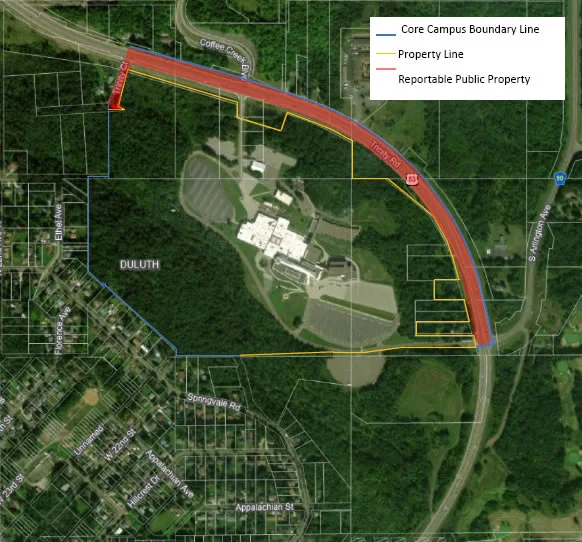
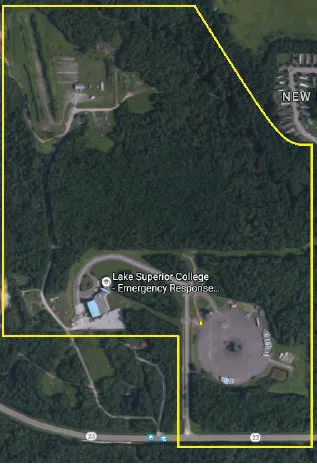
Aerial View Emergency Response Training Center Clery Reporting Area
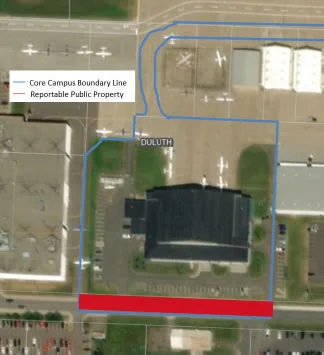
Center for Advanced Aviation Hangar Only
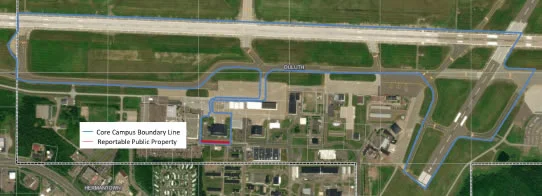
Center for Advanced Aviation Entire Airport
Non-Campus Building or Property: The term “non-campus building or property” means 1) any building or property owned or controlled by an institution; and 2) any building or property (other than a branch campus) owned or controlled by an institution of higher education that is used in direct support of, or in relation to, the institution’s educational purposes, is used by students, and is not within the same reasonably contiguous geographic area of the institution.
CY 2024 Non campus property:
Residential Construction Project
5162 Gortin Road
Rice Lake, MN 55803
Public Property: The term “public property” means all public property that is within the same reasonably contiguous geographic area of the institution, such as a sidewalk, a street, other thoroughfare, or parking facility, and is adjacent to a facility owned or controlled by the institution if the facility is used by the institution in direct support of, or in a manner related to the institution’s educational purposes.
LSC public property includes adjacent streets, parking lots, sidewalks, and stairwells.
Residence Halls: Lake Superior College does not have on campus housing.
Statistics
2022-2024 CRIME STATISTICS FOR LSC Main Campus
2101 Trinity Road, Duluth, MN 55811
| Primary Crimes | Year | On Campus | Non-Campus | Public Property | Total |
|---|---|---|---|---|---|
| Murder/Non-Negligent Manslaughter | 2024 | 0 | 0 | 0 | 0 |
| 2023 | 0 | 0 | 0 | 0 | |
| 2022 | 0 | 0 | 0 | 0 | |
| Manslaughter by Negligence | 2024 | 0 | 0 | 0 | 0 |
| 2023 | 0 | 0 | 0 | 0 | |
| 2022 | 0 | 0 | 0 | 0 | |
| Rape | 2024 | 0 | 0 | 0 | 0 |
| 2023 | 0 | 0 | 0 | 0 | |
| 2022 | 0 | 0 | 0 | 0 | |
| Fondling | 2024 | 0 | 0 | 0 | 0 |
| 2023 | 1 | 0 | 0 | 1 | |
| 2022 | 0 | 0 | 0 | 0 | |
| Incest | 2024 | 0 | 0 | 0 | 0 |
| 2023 | 0 | 0 | 0 | 0 | |
| 2022 | 0 | 0 | 0 | 0 | |
| Statutory Rape | 2024 | 0 | 0 | 0 | 0 |
| 2023 | 0 | 0 | 0 | 0 | |
| 2022 | 0 | 0 | 0 | 0 | |
| Robbery | 2024 | 0 | 0 | 0 | 0 |
| 2023 | 0 | 0 | 0 | 0 | |
| 2022 | 0 | 0 | 0 | 0 | |
| Aggravated Assault | 2024 | 0 | 0 | 0 | 0 |
| 2023 | 0 | 0 | 0 | 0 | |
| 2022 | 0 | 0 | 0 | 0 | |
| Burglary | 2024 | 0 | 0 | 0 | 0 |
| 2023 | 1 | 0 | 0 | 1 | |
| 2022 | 1 | 0 | 0 | 1 | |
| Motor Vehicle Theft | 2024 | 0 | 0 | 0 | 0 |
| 2023 | 0 | 0 | 0 | 0 | |
| 2022 | 0 | 0 | 0 | 0 | |
| Arson | 2024 | 0 | 0 | 0 | 0 |
| 2023 | 0 | 0 | 0 | 0 | |
| 2022 | 0 | 0 | 0 | 0 |
All above categories and reported alleged criminal activity do not necessarily constitute an arrest or conviction. They are allegations of wrongdoing.
Lake Superior College does not have on campus residential facilities.
Lake Superior College endorses and implements a policy of equal opportunity in employment and admission to its programs and services for all persons regardless of race, color, religion, national origin, ancestry, sex/gender, marital status, age, disability and status as a disabled veteran or sexual orientation. Reasonable accommodation and support for students with disabilities are available.
2022-2024 LIQUOR, DRUG AND WEAPONS VIOLATIONS STATISTICS FOR LSC Main Campus
2101 Trinity Road, Duluth, MN 55811
| Arrests and Referrals for Disciplinary Action | Year | On Campus | Non-campus | Public Property | Total |
|---|---|---|---|---|---|
| Liquor Law Violation Arrests | 2024 | 0 | 0 | 0 | 0 |
| 2023 | 0 | 0 | 0 | 0 | |
| 2022 | 0 | 0 | 0 | 0 | |
| Drug Law Violation Arrests | 2024 | 0 | 0 | 0 | 0 |
| 2023 | 0 | 0 | 0 | 0 | |
| 2022 | 0 | 0 | 0 | 0 | |
| Weapons Law Violation Arrests | 2024 | 0 | 0 | 0 | 0 |
| 2023 | 0 | 0 | 0 | 0 | |
| 2022 | 0 | 0 | 0 | 0 | |
| Liquor Law Violation Referrals for Disciplinary Action | 2024 | 0 | 0 | 0 | 0 |
| 2023 | 0 | 0 | 0 | 0 | |
| 2022 | 0 | 0 | 0 | 0 | |
| Drug Law Violation Referrals for Disciplinary Action | 2024 | 0 | 0 | 0 | 0 |
| 2023 | 0 | 0 | 0 | 0 | |
| 2022 | 0 | 0 | 0 | 0 | |
| Weapons Law Violation Referrals for Disciplinary Action | 2024 | 0 | 0 | 0 | 0 |
| 2023 | 0 | 0 | 0 | 0 | |
| 2022 | 0 | 0 | 0 | 0 |
All above categories and reported alleged criminal activity do not necessarily constitute an arrest or conviction. They are allegations of wrongdoing.
Lake Superior College does not have on campus residential facilities.
Lake Superior College endorses and implements a policy of equal opportunity in employment and admission to its programs and services for all persons regardless of race, color, religion, national origin, ancestry, sex/gender, marital status, age, disability and status as a disabled veteran or sexual orientation. Reasonable accommodation and support for students with disabilities are available.
2022-2024 VAWA OFFENSES STATISTICS FOR LSC Main Campus
2101 Trinity Road, Duluth, MN 55811
| VAWA Offenses | Year | On Campus | Non-campus | Public Property | Total |
|---|---|---|---|---|---|
| Domestic Violence | 2024 | 0 | 0 | 0 | 0 |
| 2023 | 0 | 0 | 0 | 0 | |
| 2022 | 1 | 0 | 0 | 1 | |
| Dating Violence | 2024 | 0 | 0 | 0 | 0 |
| 2023 | 0 | 0 | 0 | 0 | |
| 2022 | 0 | 0 | 0 | 0 | |
| Stalking | 2024 | 0 | 0 | 0 | 0 |
| 2023 | 0 | 0 | 0 | 0 | |
| 2022 | 0 | 0 | 0 | 0 |
All above categories and reported alleged criminal activity do not necessarily constitute an arrest or conviction. They are allegations of wrongdoing.
Lake Superior College does not have on campus residential facilities.
Lake Superior College endorses and implements a policy of equal opportunity in employment and admission to its programs and services for all persons regardless of race, color, religion, national origin, ancestry, sex/gender, marital status, age, disability and status as a disabled veteran or sexual orientation. Reasonable accommodation and support for students with disabilities are available.
2022-2024 CRIME STATISTICS FOR LSC EMERGENCY RESPONSE TRAINING CENTER
11501 Hwy 23, Duluth, MN 55808
| Primary Crimes | Year | On Campus | Non-campus | Public Property | Total |
|---|---|---|---|---|---|
| Murder/Non-Negligent Manslaughter | 2024 | 0 | 0 | 0 | 0 |
| 2023 | 0 | 0 | 0 | 0 | |
| 2022 | 0 | 0 | 0 | 0 | |
| Manslaughter by Negligence | 2024 | 0 | 0 | 0 | 0 |
| 2023 | 0 | 0 | 0 | 0 | |
| 2022 | 0 | 0 | 0 | 0 | |
| Rape | 2024 | 0 | 0 | 0 | 0 |
| 2023 | 0 | 0 | 0 | 0 | |
| 2022 | 0 | 0 | 0 | 0 | |
| Fondling | 2024 | 0 | 0 | 0 | 0 |
| 2023 | 0 | 0 | 0 | 0 | |
| 2022 | 0 | 0 | 0 | 0 | |
| Incest | 2024 | 0 | 0 | 0 | 0 |
| 2023 | 0 | 0 | 0 | 0 | |
| 2022 | 0 | 0 | 0 | 0 | |
| Statutory Rape | 2024 | 0 | 0 | 0 | 0 |
| 2023 | 0 | 0 | 0 | 0 | |
| 2022 | 0 | 0 | 0 | 0 | |
| Robbery | 2024 | 0 | 0 | 0 | 0 |
| 2023 | 0 | 0 | 0 | 0 | |
| 2022 | 0 | 0 | 0 | 0 | |
| Aggravated Assault | 2024 | 0 | 0 | 0 | 0 |
| 2023 | 0 | 0 | 0 | 0 | |
| 2022 | 0 | 0 | 0 | 0 | |
| Burglary | 2024 | 0 | 0 | 0 | 0 |
| 2023 | 0 | 0 | 0 | 0 | |
| 2022 | 0 | 0 | 0 | 0 | |
| Motor Vehicle Theft | 2024 | 0 | 0 | 0 | 0 |
| 2023 | 0 | 0 | 0 | 0 | |
| 2022 | 0 | 0 | 0 | 0 | |
| Arson | 2024 | 0 | 0 | 0 | 0 |
| 2023 | 0 | 0 | 0 | 0 | |
| 2022 | 0 | 0 | 0 | 0 |
All above categories and reported alleged criminal activity do not necessarily constitute an arrest or conviction. They are allegations of wrongdoing.
Lake Superior College does not have on campus residential facilities.
Lake Superior College endorses and implements a policy of equal opportunity in employment and admission to its programs and services for all persons regardless of race, color, religion, national origin, ancestry, sex/gender, marital status, age, disability and status as a disabled veteran or sexual orientation. Reasonable accommodation and support for students with disabilities are available.
2022-2024 CRIME STATISTICS FOR LSC EMERGENCY RESPONSE TRAINING CENTER
11501 Hwy 23, Duluth, MN 55808
| Arrests and Referrals for Disciplinary Action | Year | On Campus | Non-campus | Public Property | Total |
|---|---|---|---|---|---|
| Liquor Law Violation Arrests | 2024 | 0 | 0 | 0 | 0 |
| 2023 | 0 | 0 | 0 | 0 | |
| 2022 | 0 | 0 | 0 | 0 | |
| Drug Law Violation Arrests | 2024 | 0 | 0 | 0 | 0 |
| 2023 | 0 | 0 | 0 | 0 | |
| 2022 | 0 | 0 | 0 | 0 | |
| Weapons Law Violation Arrests | 2024 | 0 | 0 | 0 | 0 |
| 2023 | 0 | 0 | 0 | 0 | |
| 2022 | 0 | 0 | 0 | 0 | |
| Liquor Law Violation Referrals for Disciplinary Action | 2024 | 0 | 0 | 0 | 0 |
| 2023 | 0 | 0 | 0 | 0 | |
| 2022 | 0 | 0 | 0 | 0 | |
| Drug Law Violation Referrals for Disciplinary Action | 2024 | 0 | 0 | 0 | 0 |
| 2023 | 0 | 0 | 0 | 0 | |
| 2022 | 0 | 0 | 0 | 0 | |
| Weapons Law Violation Referrals for Disciplinary Action | 2024 | 0 | 0 | 0 | 0 |
| 2023 | 0 | 0 | 0 | 0 | |
| 2022 | 0 | 0 | 0 | 0 |
All above categories and reported alleged criminal activity do not necessarily constitute an arrest or conviction. They are allegations of wrongdoing.
Lake Superior College does not have on campus residential facilities.
Lake Superior College endorses and implements a policy of equal opportunity in employment and admission to its programs and services for all persons regardless of race, color, religion, national origin, ancestry, sex/gender, marital status, age, disability and status as a disabled veteran or sexual orientation. Reasonable accommodation and support for students with disabilities are available.
2022-2024 CRIME STATISTICS FOR LSC EMERGENCY RESPONSE TRAINING CENTER
11501 Hwy 23, Duluth, MN 55808
| VAWA Offenses | Year | On Campus | Non-campus | Public Property | Total |
|---|---|---|---|---|---|
| Domestic Violence | 2024 | 0 | 0 | 0 | 0 |
| 2023 | 0 | 0 | 0 | 0 | |
| 2022 | 0 | 0 | 0 | 0 | |
| Dating Violence | 2024 | 0 | 0 | 0 | 0 |
| 2023 | 0 | 0 | 0 | 0 | |
| 2022 | 0 | 0 | 0 | 0 | |
| Stalking | 2024 | 0 | 0 | 0 | 0 |
| 2023 | 0 | 0 | 0 | 0 | |
| 2022 | 0 | 0 | 0 | 0 |
All above categories and reported alleged criminal activity do not necessarily constitute an arrest or conviction. They are allegations of wrongdoing.
Lake Superior College does not have on campus residential facilities.
Lake Superior College endorses and implements a policy of equal opportunity in employment and admission to its programs and services for all persons regardless of race, color, religion, national origin, ancestry, sex/gender, marital status, age, disability and status as a disabled veteran or sexual orientation. Reasonable accommodation and support for students with disabilities are available.
2022-2024 CRIME STATISTICS FOR LSC CENTER FOR ADVANCED AVIATION
Hangar 103 4960 Airport Rd, Duluth, MN 55811
| Primary Crime | Year | On Campus | Non-campus | Public Property | Total |
|---|---|---|---|---|---|
| Murder/Non-Negligent Manslaughter | 2024 | 0 | 0 | 0 | 0 |
| 2023 | 0 | 0 | 0 | 0 | |
| 2022 | 0 | 0 | 0 | 0 | |
| Manslaughter by Negligence | 2024 | 0 | 0 | 0 | 0 |
| 2023 | 0 | 0 | 0 | 0 | |
| 2022 | 0 | 0 | 0 | 0 | |
| Rape | 2024 | 0 | 0 | 0 | 0 |
| 2023 | 0 | 0 | 0 | 0 | |
| 2022 | 0 | 0 | 0 | 0 | |
| Fondling | 2024 | 0 | 0 | 0 | 0 |
| 2023 | 0 | 0 | 0 | 0 | |
| 2022 | 0 | 0 | 0 | 0 | |
| Incest | 2024 | 0 | 0 | 0 | 0 |
| 2023 | 0 | 0 | 0 | 0 | |
| 2022 | 0 | 0 | 0 | 0 | |
| Statutory Rape | 2024 | 0 | 0 | 0 | 0 |
| 2023 | 0 | 0 | 0 | 0 | |
| 2022 | 0 | 0 | 0 | 0 | |
| Robbery | 2024 | 0 | 0 | 0 | 0 |
| 2023 | 0 | 0 | 0 | 0 | |
| 2022 | 0 | 0 | 0 | 0 | |
| Aggravated Assault | 2024 | 0 | 0 | 0 | 0 |
| 2023 | 0 | 0 | 0 | 0 | |
| 2022 | 0 | 0 | 0 | 0 | |
| Burglary | 2024 | 0 | 0 | 0 | 0 |
| 2023 | 0 | 0 | 0 | 0 | |
| 2022 | 0 | 0 | 0 | 0 | |
| Motor Vehicle Theft | 2024 | 0 | 0 | 0 | 0 |
| 2023 | 0 | 0 | 0 | 0 | |
| 2022 | 0 | 0 | 0 | 0 | |
| Arson | 2024 | 0 | 0 | 0 | 0 |
| 2023 | 0 | 0 | 0 | 0 | |
| 2022 | 0 | 0 | 0 | 0 |
All above categories and reported alleged criminal activity do not necessarily constitute an arrest or conviction. They are allegations of wrongdoing.
Lake Superior College does not have on campus residential facilities.
Lake Superior College endorses and implements a policy of equal opportunity in employment and admission to its programs and services for all persons regardless of race, color, religion, national origin, ancestry, sex/gender, marital status, age, disability and status as a disabled veteran or sexual orientation. Reasonable accommodation and support for students with disabilities are available.
2022-2024 CRIME STATISTICS FOR LSC CENTER FOR ADVANCED AVIATION
Hangar 103 4960 Airport Rd, Duluth, MN 55811
| Arrests and Referrals for Disciplinary Action | Year | On Campus | Non-campus | Public Property | Total |
|---|---|---|---|---|---|
| Liquor Law Violation Arrests | 2024 | 0 | 0 | 0 | 0 |
| 2023 | 0 | 0 | 0 | 0 | |
| 2022 | 0 | 0 | 0 | 0 | |
| Drug Law Violation Arrests | 2024 | 0 | 0 | 0 | 0 |
| 2023 | 0 | 0 | 0 | 0 | |
| 2022 | 0 | 0 | 0 | 0 | |
| Weapons Law Violation Arrests | 2024 | 0 | 0 | 0 | 0 |
| 2023 | 0 | 0 | 0 | 0 | |
| 2022 | 0 | 0 | 0 | 0 | |
| Liquor Law Violation Referrals for Disciplinary Action | 2024 | 0 | 0 | 0 | 0 |
| 2023 | 0 | 0 | 0 | 0 | |
| 2022 | 0 | 0 | 0 | 0 | |
| Drug Law Violation Referrals for Disciplinary Action | 2024 | 0 | 0 | 0 | 0 |
| 2023 | 0 | 0 | 0 | 0 | |
| 2022 | 0 | 0 | 0 | 0 | |
| Weapons Law Violation Referrals for Disciplinary Action | 2024 | 0 | 0 | 0 | 0 |
| 2023 | 0 | 0 | 0 | 0 | |
| 2022 | 0 | 0 | 0 | 1 |
All above categories and reported alleged criminal activity do not necessarily constitute an arrest or conviction. They are allegations of wrongdoing.
Lake Superior College does not have on campus residential facilities.
Lake Superior College endorses and implements a policy of equal opportunity in employment and admission to its programs and services for all persons regardless of race, color, religion, national origin, ancestry, sex/gender, marital status, age, disability and status as a disabled veteran or sexual orientation. Reasonable accommodation and support for students with disabilities are available.
2022-2024 CRIME STATISTICS FOR LSC CENTER FOR ADVANCED AVIATION
Hangar 103 4960 Airport Rd, Duluth, MN 55811
| VAWA Offenses | Year | On Campus | Non-campus | Public Property | Total |
|---|---|---|---|---|---|
| Domestic Violence | 2024 | 0 | 0 | 0 | 0 |
| 2023 | 0 | 0 | 0 | 0 | |
| 2022 | 0 | 0 | 0 | 0 | |
| Dating Violence | 2024 | 0 | 0 | 0 | 0 |
| 2023 | 0 | 0 | 0 | 0 | |
| 2022 | 0 | 0 | 0 | 0 | |
| Stalking | 2024 | 0 | 0 | 0 | 0 |
| 2023 | 0 | 0 | 0 | 0 | |
| 2022 | 0 | 0 | 0 | 0 |
All above categories and reported alleged criminal activity do not necessarily constitute an arrest or conviction. They are allegations of wrongdoing.
Lake Superior College does not have on campus residential facilities.
Lake Superior College endorses and implements a policy of equal opportunity in employment and admission to its programs and services for all persons regardless of race, color, religion, national origin, ancestry, sex/gender, marital status, age, disability and status as a disabled veteran or sexual orientation. Reasonable accommodation and support for students with disabilities are available.
Unfounded Crimes
If a crime is reported as occurring On Campus, in On-campus Residential Facilities, in or on non-campus buildings or property, or on Public Property, and the reported crime is investigated by sworn or commissioned law enforcement authorities and found to be false or baseless, the crime is considered to be “unfounded.” Institutions must report the total number of criminal offenses; hate crimes; and domestic violence, dating violence, or stalking incidents that have been unfounded.
There were no unfounded crimes in 2022, 2023 or 2024 at the LSC Main Campus.
There were no unfounded crimes in 2022, 2023 or 2024 at the LSC Emergency Response Training Center. There were no unfounded crimes in 2022, 2023 or 2024 at the LSC Center for Advanced Aviation.
Hate Crimes
Lake Superior College strives to foster a safe and healthy learning environment that embodies diversity and inclusion of all members of the LSC community. The Hate Crime statistics are separated by the category of prejudice.
If a crime occurs where there is a criminal incident involving the following offenses:
- Murder and Non-Negligent Manslaughter
- Sexual Assault
- Robbery
- Aggravated Assault
- Burglary
- Motor Vehicle Theft
- Arson
- Larceny-Theft
- Simple Assault
- Intimidation
- Destruction/Damage/Vandalism of Property
Which is determined to be motivated by the offender’s bias. The Clery Act requires that the statistics be reported as a hate crime even though there is no requirement to report the crime classification in any other area of the compliance document.
Note: A hate or bias related crime is not a separate, distinct crime, but is the commission of a criminal offense which was motivated by the offender’s bias. For example, a subject assaults a victim, which is a crime. If the facts of the case indicate that the offender was motivated to commit the offense because of his/her bias against the victim’s race, religion, sexual orientation, gender, ethnicity, national origin, or disability, the assault is then also classified as a hate/bias crime.
Hate Crime Reporting:
The LSC Main Campus had no hate crimes reported in 2022, 2023, or 2024.
The LSC Emergency Response Training Center had no hate crimes reported in 2022, 2023, or 2024. The LSC Center for Advanced Aviation had no hate crimes reported in 2022, 2023, or 2024.
Stop Campus Hazing Act:
Hazing Policy and Reporting under the Stop Campus Hazing Act
Lake Superior College is committed to fostering a safe and inclusive campus environment free from hazing. In compliance with the Stop Campus Hazing Act, signed into law on December 23, 2024, and effective as of January 1, 2025, the institution has implemented policies and procedures to prevent, address, and report hazing incidents. This federal legislation amends the Jeanne Clery Disclosure of Campus Security Policy and Campus Crime Statistics Act (Clery Act) to include hazing as a reportable offense, and mandates enhanced transparency and prevention efforts.
Definition of Hazing
Any intentional, knowing, or reckless act committed by a person (whether individually or in concert with other persons) against another person or persons regardless of the willingness of such other person or persons to participate, that-
- Is committed in the course of an initiation into, an affiliation with, or the maintenance of membership in, a student organization; and
- Causes or creates a risk, above the reasonable risk encountered in the course of participation in the institution or the organization (such as the physical preparation necessary for participation in an athletic team), of physical or psychological injury including-
- Whipping, beating, striking, electronic shocking, placing of a harmful substance on
someone’s body, or similar activity; - Causing, coercing or otherwise inducing sleep deprivation, exposure to the elements, confinement in a small space, extreme calisthenics, or similar activity;
- Causing, coercing or otherwise inducing another person to consume food, liquid, alcohol, drugs, or other substances;
- Causing, coercing or otherwise inducing another person to perform sexual acts;
- Any activity that places another person in reasonable fear of bodily harm through the use of threatening words or conduct;
- Any activity against another person that includes a criminal violation of local, State,
Tribal, or Federal law; and - Any activity that induces, causes, or requires another person to perform a duty or task that involves a criminal violation of local, State, Tribal, or Federal law.
- Whipping, beating, striking, electronic shocking, placing of a harmful substance on
The current Minnesota State policy 3.6 and Lake Superior College Procedure 3.6.1 regarding hazing is as follows:
Colleges and universities may hold students accountable for a violation of the behavioral proscriptions contained in their student codes of conduct committed on/off campus when:
- Hazing is involved; or
- The violation is committed while participating in a college- or university-sanctioned or sponsored activity; or
- The victim of the violation is a member of the college or university community; or
- The violation constitutes a felony under state or federal law; or
- The violation adversely affects the educational, research, or service functions of the college or university.
Reporting Hazing Incidents
Lake Superior College collects statistics on hazing incidents reported to campus security authorities or local law enforcement, as required by the Stop Campus Hazing Act. These statistics are compiled for inclusion in the Annual Security Report. Reported incidents occurring on campus, in or on non-campus buildings or property, or on public property within or immediately adjacent to campus, as defined by the Clery Act, are included in these statistics.
To report a hazing incident, individuals may contact the Public Safety Office at 218-733-6911, the Dean of Students at 218-733-7656 or submit a report through Maxient at www.lsc.edu/safety. Campus security authorities, as defined under the Clery Act, are trained to recognize and report hazing incidents to ensure accurate data collection.
Anti-Hazing Investigation
Hazing incidents will follow the normal Student Code of Conduct investigation process outlined elsewhere in this report.
Hazing Statistics
Data collection for hazing incidents began on January 1, 2025, and will be reported in the 2026 Annual Security Report, covering incidents from the 2025 calendar year. No statistics are available for prior years, as this is a new reporting requirement under the Stop Campus Hazing Act.
Hazing Prevention and Awareness Programs
In accordance with the Stop Campus Hazing Act, Lake Superior College has implemented a comprehensive, campus-wide hazing prevention program, effective June 23, 2025. This program includes:
- Hazing awareness and prevention education for all incoming students during Student Code of Conduct orientation;
- Annual training for CSAs recognizing, preventing, and reporting hazing;
- Inclusion of hazing recognition and prevention awareness materials in club advisor handbooks; and
- Resources and support services for students affected by hazing, available through Student Life
Campus Hazing Transparency Report
Beginning July 1, 2025, Lake Superior College collects information on hazing incidents involving student organizations found in violation of our standards of conduct. If any incidents occur, this information is summarized in the Campus Hazing Transparency Report (CHTR), which is publicly available on our website at www.lsc.edu no later than December 23, 2025, and updated at least twice annually (January 15 and July 15). The CHTR includes the name of the organization, a general description of the violation, dates of the incident and investigation, findings, and any sanctions imposed, while protecting personally identifiable information in compliance with applicable privacy laws.
Applicable Laws:
Minnesota Statute 135A.155 HAZING POLICY.
The Board of Trustees of the Minnesota State Colleges and Universities shall, …, adopt a clear, understandable written policy on student conduct, including hazing. The policy must include procedures for reporting incidents of inappropriate hazing and for disciplinary actions against individual violators and organizations. The policy shall be made available to students by appropriate means as determined by each institution, which may include publication in a student handbook or other institutional publication, or posting by electronic display on the Internet, and shall be posted at appropriate locations on campus.
20 U.S. Code § 1092(f) Jeanne Clery Campus Safety Act
Emergency Response and Evacuation Procedure
Lake Superior College is required by policy and fire code to have evacuation and emergency operations plans in place. Evacuation plans and emergency procedures are posted in each classroom and can be found on the LSC Public Safety website. Lake Superior College also has a current Emergency Operations Plan based on the all-hazards concept, incorporating the National Incident Management System and coordinating with the system office and local emergency response agencies. This plan is used to respond to any level of emergency impacting LSC and outlines the responsibilities and actions necessary to protect life, property and the environment. Some of the processes and procedures are included in this report.
Emergency Response: Lake Superior College will immediately notify the campus community upon confirmation of a significant emergency or dangerous situation involving an immediate threat to the health and safety of students, faculty or staff occurring on campus. Lake Superior College has numerous systems for communicating information quickly. Some or all these methods of communication may be activated in the event of an immediate threat. These methods of communication include but are not limited to:
Active messaging: Lake Superior College has the ability to address the campus through a VoIP phone system to reach all campus offices and classrooms.
Passive messaging: Lake Superior College will provide emergency information via the main web page. The administration will use campus wide mass email and any other available media such as signs to disseminate emergency notifications to students, faculty and staff. Twitter and Facebook social media will also be used to disseminate emergency notification either individually or through the Star Alert system.
Individual messaging: Lake Superior College utilizes an emergency notification system named Star Alert, provided by Blackboard Connect, which disseminates emergency notification through SMS text, direct phone calls and email, at the selection of the recipient. This is an opt out/in system.
Upon enrollment or hiring students/faculty/staff are automatically enrolled in the system using the Star ID to associate them with Lake Superior College. Students, faculty and staff are sent an automatic email, activating their account and encouraging them to enter additional phone and/or cell numbers, email addresses and selecting other delivery options for receiving emergency notifications. The emergency notification system is updated weekly.
Students, faculty and staff have the option of permanently opting out of Star Alert should they choose. For additional information on access, issues concerning individual accounts or other questions contact: Ryan Schaeffer, Senior Data Center Administrator at .
Lake Superior College also uses the Informacast mass notification system. This is a network- based system. Students, faculty and staff receive messages on desktop computers or campus Cisco phones.
Face to Face Communication: If any of these systems fail or the College deems it appropriate, in person communication may be used to communicate an emergency.
Upon confirmation of a significant emergency or dangerous situation involving an immediate threat to the health and safety of students or employees occurring on campus:
- A Lake Superior College Cabinet member will confirm/verify that a legitimate emergency or dangerous situation exists, even if all the pertinent details are not known or are available at the time, sometimes in conjunction with campus administrators, local first responders and/or the national weather center.
- Lake Superior College Vice President of Administration or designee in coordination with and at the advice of local first responders, will determine the appropriate segment(s) of the campus community to receive notification.
- Lake Superior College will immediately, and considering the safety of the community, determine the content of the notification, unless issuing a notification will, in the professional judgement of responsible authorities, compromise efforts to assist a victim or to contain, respond to, or otherwise mitigate the emergency.
The following people or organization(s) are responsible for emergency notification dissemination:
Those responsible for emergency notification dissemination include the Vice President of Administration, Dean of Student Affairs, Occupational Safety Coordinator, Public Safety Coordinator, Information Officer, Chief Information Officer, and Enterprise Technology System Administrator. The LSC’s Public Safety Department, or Vice President of Administration or Vice President of Advancement and External Relations and Media Relations will collaborate to determine the content of the message and will use some or all of the systems described above to communicate the threat to the LSC community.
Lake Superior College, after ensuring that local first responders are notified, will activate the active messaging system to provide emergency notification to the campus community. An immediate Star Alert containing pertinent emergency notification and information will be disseminated. Other passive and individual messaging will provide redundant and detailed emergency information as soon as reasonably possible. Any follow-up information will be distributed using some or all of the identified communication systems (except fire alarm).
The local news media may be utilized to disseminate emergency information to members of the larger community, including neighbors, parents and other interested parties. The larger community can also access emergency information via the Lake Superior College homepage and/or social media.
If there is an immediate threat to the health or safety of students or employees occurring on campus, an institution must follow its emergency notification procedures. An institution that follows its emergency notification procedures is not required to issue a timely warning based on the same circumstances; however, the institution must provide adequate follow-up information to the community as needed.
Lake Superior College will test the emergency response and evacuation procedures annually in accordance with this policy and applicable state and federal regulations. Tests may be announced, or unannounced and emergency response and evacuation procedures will be publicized in conjunction with at least one test per calendar year. Results of each test will be documented and include a description of the exercise, the date, time, and whether it was announced or unannounced. This information will be maintained. The Public Safety Coordinator maintains this information. Records for all Clery related requirements are maintained for seven years and available upon request.
Emergency Evacuation Procedures
The emergency evacuation procedures are tested at least twice each year. The LSC Public Safety Department does not tell building occupants in advance about the designated locations for long-term evacuations because those decisions are affected by time of day, location of the building being evacuated, the availability of the various designated emergency gathering locations on campus, and other factors such as the location and nature of the threat. In both cases, LSC Public Safety Department staff on the scene will communicate information to students regarding the developing situation or any evacuation status changes.
The purpose of evacuation drills is to prepare building occupants for an organized evacuation in case of a fire or other emergency. At LSC, tabletop evacuation drills are used to educate and train on fire safety issues specific to their building and may account for these instances.
General Evacuation Procedures
At the sound of a fire alarm or if you are instructed to evacuate, leave your work area immediately and proceed to the nearest exit, and leave the building. If you are the first to recognize a fire situation, activate the alarm, evacuate to a safe location using the nearest exit, and dial 911. If it is safe to do so, notify LSC Public Safety at 218-733-6911.
- Remain Calm
- Do NOT use elevators, use the stairs.
- Assist the physically impaired. If a person is unable to exit without using an elevator, secure a safe location near a stairwell, and immediately inform LSC Public Safety or the responding Fire Dept. of the individual’s location.
- Proceed to a clear area at least 150 feet from the building. Keep all walkways clear for emergency vehicles.
- Make sure all personnel are out of the building.
- Do not re-enter the building.
Shelter-in-Place Procedures –What it Means to “Shelter-in-Place.”
If an incident occurs and the buildings or areas around you become unstable, or if the air outdoors becomes dangerous due to toxic or irritating substances, it is usually safer to stay indoors, because leaving the area may expose you to that danger. Thus, to “shelter-in-place” means to make a shelter of the building that you are in, and with a few adjustments this location can be made even safer and more comfortable until it is safe to go outside.
Basic “Shelter-in-Place” Guidance
If an incident occurs and the building you are in is not damaged, stay inside an interior room until you are told it is safe to come out. If your building is damaged, take your personal belonging (purse, wallet, access card, etc.) and follow the evacuation procedures for your building (close your door, proceed to the nearest exit, and use the stairs instead of the elevators). Once you have evacuated, seek shelter at the nearest college building quickly. If police or fire department personnel are on the scene, follow their directions.
How You Will Know to “Shelter-in-Place”
A shelter-in-place notification may come from several sources, such as LSC Public Safety, College staff, Duluth Police Department, or other authorities utilizing the College’s emergency communications tools.
How to “Shelter–in-Place”
No matter where you are, the basic steps of shelter-in-place will generally remain the same. Should the need ever arise, follow these steps, unless instructed otherwise by local emergency personnel:
- If you are inside, stay where you are. Collect any emergency shelter-in-place supplies and a telephone to be used in case of emergency. If you are outdoors, proceed into the closest building quickly or follow instructions from emergency personnel on the scene.
- Locate a room to shelter inside. It should be:
- An interior room
- Above ground level; and
- Without windows or with the least number of windows. If there is a large group of people inside a building, several rooms may be necessary.
- Shut and lock all windows (tighter seal) and close exterior doors.
- Turn off air conditioners, heaters, and fans.
- Close vents to ventilation systems as you are able. (Maintenance will turn off the ventilation as quickly as possible.)
- Make a list of the people with you and ask someone (hall staff, faculty, or other staff) to call the list in to the LSC Public Safety Department so they know where you are sheltering. If only students are present, one of the students can call in the list.
- Turn on a radio or TV and listen for further instructions.
- Make yourself comfortable.
Timely Warning Notice Procedures
Lake Superior College will issue a timely warning for all Clery Act crimes reported to Campus Security Authorities or local police agencies that occur on or within the LSC Clery Geography (on Campus, Public Property and Non campus property), and considered by Lake Superior College officials to represent a serious or continuing threat to students, faculty and staff. Timely warning will not be limited to violent crimes or crimes against people and may include crimes against property or other types of serious or continuing threats.
Timely Warnings are typically issued for the following Uniform Crime Reporting Program (UCR)/National Incident Based Reporting System (NIBRS) crime classifications:
- Murder/Non-Negligent Manslaughter
- Aggravated Assault. Cases involving assaults among known parties, such as two roommates fighting which results in an aggravated injury, will be evaluated on a case-by-case basis to determine if the individual is believed to be an ongoing threat to the larger LSC community.
- Robbery involving force or violence. Cases including pick pocketing and purse snatching will typically not result in the issuance of a Timely Warning Notice but will be assessed on a case-by- case basis.
- Sexual Assault (considered on a case-by-case basis depending on the facts of the case, when and where the incident occurred, when it was reported, and the amount information known by the Click here to enter text., or designee). In cases involving sexual assault, they are often reported long after the incident occurred, thus there is no ability to distribute a “timely” warning notice to the community. All cases of sexual assault, including stranger and non-
stranger/acquaintance cases, will be assessed for potential issuance of a Timely Warning Notice. - Major incidents of Arson
- Other Clery crimes as determined necessary by the Public Safety Coordinator, or his/her designee in his/her absence.
Issuance of a Timely Warning is determined on a case-by-case basis. Factors included are the nature of the crime or threat, the continuing danger to the campus community and the possible risk of compromising law enforcement efforts. Lake Superior College will consult with local law enforcement and other officials when determining the need and content of any Timely Warning.
Timely Warning Notices will be distributed as soon as pertinent information is available, in a manner that withholds the names of victims as confidential, and with the goal of aiding in the prevention of similar occurrences. The institution is not required to issue a Timely Warning with respect to crimes reported to a pastoral or professional counselor.
Timely Warning Notices are typically written and distributed by the Vice President of Institutional Advancement and External Relations. If they are unavailable, the LSC President or any Cabinet members, or the Public Safety Coordinator may write and distribute a Timely Warning Notice.
The intent of a Timely Warning is to enable the campus community to protect themselves and will include all information that would promote safety and aid in the prevention of similar crimes or protection from specific threats. Timely Warnings will be disseminated using the Star Alert text and email features, campus email system, Informacast notification system, or face to face method of notification to students, faculty and staff.
Campus Security Policies
All criminal activity occurring on campus should be reported immediately to Lake Superior College Security or others listed above, in person at LSC Security or by telephone at 218-733-6911. If the victim chooses, an additional report can be filed with the appropriate local law enforcement agency. Lake Superior College Public Safety or others listed above can assist the complainant in completing reports. Internal reports may be shared with other departments on campus as necessary to complete an investigation and/or to ensure the safety of the campus community. The Public Safety Department or others listed above will assist the Police Department(s) with investigations as required. Depending on many factors, Lake Superior College may or may not hold reports of crime in confidence and may be required by law to release information based on the events or nature of the crime. Whenever possible Lake Superior College will attempt to protect the identity of crime victims.
Campus Security Authorities
All employees who become aware of an allegation or violation of College policy, Student Code of Conduct, civil or criminal law are encouraged to report the allegation to their supervisor and to the Public Safety Department.
While we prefer that reports are made directly to the Public Safety Department or through the reporting feature on the Safety Website (explained below), the campus community is invited to make a report of crime to any Campus Security Authority on campus. If a Campus Security Authority becomes aware of any alleged crime, they must report it to the Public Safety Department. Campus Security Authorities do not investigate crime reports. They ensure that any alleged crimes that they are made aware of are forwarded to the Public Safety Department for classification and investigation.
Campus security authority is defined as:
- A campus police department or a campus Public Safety department of an institution.
- Any individual or individuals who have responsibility for campus security but who do not constitute a campus police department or a campus Public Safety department.
- Any individual or organization specified in the institution’s statement of campus Public Safety policy as an individual or organization to which students and employees should report criminal offenses.
- An official of an institution who has significant responsibility for student and campus activities, including, but not limited to, student housing, student discipline, and campus judicial proceedings.
Lake Superior College offers an anonymous reporting program via Maxient reporting software on the Safety/Security webpage for victims and/or witnesses to report crimes on a voluntary, confidential basis for inclusion in the annual security report. Lake Superior College officials will share information as necessary to appropriately address a situation but will make efforts to maintain confidentiality.
Absolute confidentiality of reports made to Lake Superior College officials cannot be promised.
Lake Superior College Public Safety personnel and officials ARE NOT certified or sworn peace officers and do not possess law enforcement (arrest) authority. Lake Superior College personnel may utilize private person arrest authority pursuant to Minnesota State Statute 629.37 when appropriate.
Lake Superior College works closely with the Duluth Police Department, Minnesota State Patrol, Bureau of Criminal Apprehension, and other state and federal law enforcement agencies when required.
LSC does not have officially recognized student organizations that own or control housing facilities outside of the LSC core campus. Therefore, Duluth Police Department is not used to monitor and record criminal activity since there are no non-campus locations of student organizations.
Lake Superior College encourages students, faculty and staff to accurately and promptly report all crimes to one of the above listed agencies and offices.
Security Considerations Used in the Maintenance of Campus Facilities
Lake Superior College continuously reviews the physical security infrastructure to ensure appropriate steps are taken to maintain and enhance the public safety of the campus. Landscaping and lighting are checked regularly, and discrepancies are addressed immediately. The campus works closely and routinely with the system office Emergency Preparedness and Security Specialist and the LSC Facilities department to evaluate campus physical security and vulnerability, programming resources to address any potential threats, vulnerabilities or contingencies.
Access and Security of Campus Facilities
The campus and all facilities are typically open during the following hours:
Main Campus:
Regular Hours
Monday–Friday: 6:30 am–8:00 pm Saturday: By Arrangement Sunday: By Arrangement
Winter / Spring break
Monday–Thursday: 6:30 am-6:00 pm Friday: 6:30 am -5:00 pm
Saturday-Sunday: By Arrangement
Summer hours
Monday–Thursday: 6:30 am – 8:00 pm
Friday: 6:30 am – 5:00 pm Saturday-Sunday: By Arrangement
Center for Advanced Aviation: Regular hours
Monday–Friday: 7:30 am – 11:00 pm Variable flight hours: By Arrangement Saturday & Sunday: By Arrangement Winter / Spring break
By Arrangement only
Summer hours
Monday-Friday: 7:30 am– 11:00 pm Saturday-Sunday: By Arrangement Flight hours: By Arrangement
Emergency Response Training Center Regular hours
Monday–Friday: 6:00 am–10:00 pm Saturday & Sunday: By Arrangement Winter / Spring break
By Arrangement Only
Summer Hours:
Monday – Friday: 6:00 am – 4:00 pm Saturday-Sunday: By Arrangement
Campus facilities, offices, classrooms and other spaces use a combination of keyless entry via electronic badge readers and manual operated locks with keys being given to authorized personnel only. Typically, Public Safety /maintenance opens and/or grants access and secures all facility access points after hours. All exterior doors are controlled electronically. Gates are opened with keys – exterior doors at the Emergency Response Training Center are also electronic. The entrance gate at the ERTC is on an electronic badge access loop.
Public Safety Officers conduct routine patrols on foot of campus buildings and by vehicle for the campus grounds to evaluate and monitor security related matters. Occupational and Public Safety Coordinators conduct routine patrols on foot of all campus buildings on a regular basis to monitor security and safety related issues. The Main Campus Public Safety post is located by the East Entrance doors. Lake Superior College does not have on campus residential facilities, therefore there are no policies for access and security in those types of facilities. The Public Safety Coordinator’s office is located at L240.
Campus Duty Days offer the opportunity to provide safety training. First Aid, AED, CPR, Active Assailant, MOAB training, de-escalation techniques, etc. and are offered throughout the year upon request. Training is offered by the Occupational Safety Coordinator, Public Safety Coordinator, or contracted professionals. Emails regarding public safety procedures are sent to students, faculty and staff throughout the school year. Topics such as personal safety, drug and alcohol abuse awareness and sexual assault prevention are some examples of programs that will be offered during the academic year.
Lake Superior College includes information in crime prevention and security awareness programs that encourages students, faculty and staff to be responsible for their own security and the security of others by following the tips provided.
As part of the department’s community-oriented policing philosophy, LSC Public Safety Department offers crime prevention presentations each semester to classrooms, campus clubs and student groups as requested. Topics of these presentations include personal safety awareness, Rape Aggression Defense (R.A.D.) and property protection strategies. Anyone interested in having an LSC Public Safety Department staff or contracted professionals speak to his or her classroom or group should contact them at 218-733-6816.
Protect your room or apartment:
- Lock your door – even if you are only going out for a short time. It only takes 8 seconds to walk into an open room and steal your valuables.
- Always lock your door and windows when you are asleep. You are also encouraged to lock your door and windows when you are awake.
- Do not prop open locked exterior building doors. These doors are locked for your protection and the protection of other residents.
- Never open exterior doors of the building for strangers or non-residents. Always escort your guests to and from the main entrance doors.
- Do not loan your keys or Student ID card swipe to anyone – even a classmate or friend. They may not be careful with them and may misplace them, giving the wrong person access.
- Do not put your name or address on key rings as they may be used to steal your property if found by the wrong person.
- Smoke detectors are provided in each housing unit for your safety. AT NO TIME SHOULD THEY BE DISCONNECTED OR REMOVED (or a fee may be imposed).
Protect your property:
- Personal property (purses, backpacks, calculators, cell phones, etc.) should never be left unattended. Take such items with you if you are leaving the office, classroom, or your residence.
- Take valuables home with you during vacations and school breaks.
- Park your bike where you can keep an eye on it if possible. Always lock your bike.
Protect your automobile:
- Always lock your car doors and never leave your keys or valuable items such as cameras, wallets, etc. in plain sight or on the seats in the vehicle.
- Try to park your car in a well-lit area.
Protect yourself at night:
- Avoid walking alone at night.
- Refrain from taking shortcuts; walk where there is plenty of light and traffic.
- Call for an escort in advance.
Protect yourself while walking and jogging:
- Avoid walking and jogging alone after dark. If you must travel alone at night, call for someone to escort you to your on-campus destination.
- Walk along well-lit routes.
- Be alert to your surroundings. If you suspect you are being followed, run in a different direction, go to the other side of the street and yell for help, or head quickly for a lighted area or a group of people.
- Have your keys ready when returning to your residence or apartment and keep your personal or valuable items concealed and close to your body.
Help us protect you:
- Watch for suspicious people in and around college buildings and in parking lots. Do not pursue them. Call 911 first and then:
- Suspicious activity:
- If you see any suspicious activity or people on or near campus, call law enforcement. Do not assume that what you observe is an innocent activity or that it has already been reported.
- Do not assume the person is a visitor or college staff member that you have not seen before.
- Suspicious people may be:
- Loitering about at unusual hours and locations; running, especially if something of value is being carried.
- Exhibiting unusual mental or physical symptoms. Person(s) could be under the influence of drugs or otherwise needing medical or psychiatric assistance.
- Carrying property that might be suspicious, depending on the circumstances, going from room to room trying door handles.
- Suspicious activity:
- Report all thefts and property loss immediately to Campus Public Safety.
- Always be security conscious.
Daily Crime Log
Lake Superior College has a Security Department, and therefore maintains a written daily crime log. The crime log records by date the crime was reported, any crime that occurred within the institutions designated Clery geography and that is reported to the Security Department. The information in the crime log contains the nature, date, time and general location of each crime and disposition of the complaint, if known. Lake Superior College MUST make an entry or an addition to an entry to the log within two business days of the report of the information to the Security Department unless that disclosure is prohibited by law or would jeopardize the confidentiality of the victim.
The institution may withhold information required if there is clear and convincing information that the release of the information would:
- Jeopardize an ongoing criminal investigation or the safety of an individual,
- Cause a suspect to flee or evade detection, or
- Result in the destruction of evidence.
Lake Superior College may disclose any information withheld once the adverse effect described above is no longer likely to occur. The institution can withhold only that information that would cause the adverse effect.
The Public Safety Department makes the crime log for the most recent 60-day period open to public inspection during normal business hours. The log is located at the Public Safety post located at the East Entrance doors of the Main Campus at 2101 Trinity Road Duluth, MN 55811. Lake Superior College must also make any portion of the crime log, older than 60 days available within two business days or a request for inspection. This request must be made directly to the Security Department.
Violence Against Women Act (VAWA) Policies and Programmatic Procedures
Lake Superior College follows the Minnesota State Board Policy 1B.3 Sexual Violence, System Procedure 1B.3.1 Response to Sexual Violence, and System Procedure 1B.1.1 Report/Complaint of Discrimination and Harassment Investigation and Resolution
Lake Superior College does not discriminate on the basis of sex in its educational programs and sexual harassment and sexual violence are types of sex discrimination. Sexual violence includes a continuum of conduct that includes sexual assault, dating and relations violence, stalking, as well as aiding acts of sexual violence. As a result, Lake Superior College issues this statement of policy to inform the community of our comprehensive plan addressing sexual misconduct, educational programs, and procedures that address sexual assault, domestic violence, dating violence, and stalking, whether the incident occurs on or off campus and when it is reported to a Lake Superior College official. In this context, Lake Superior College prohibits the offenses of domestic violence, dating violence, sexual assault and stalking and reaffirms its commitment to maintain a campus environment emphasizing the dignity and worth of all members of the College community.
This policy applies to all LSC students and employees and to others, as appropriate, where incidents of sexual violence on system property have been reported. Reports of sexual violence committed by a student at a location other than on system property are covered by this policy pursuant to the factors listed in Minnesota State Board Policy 3.6, Part 2, Off-campus Conduct. Reports of sexual violence committed by a system employee at a location other than system property are covered by this policy.
Reports of sexual violence committed on system property by individuals who are not students or employees are subject to appropriate actions by LSC, including, but not limited to, pursuing criminal or civil action against them.
Allegations of discrimination or harassment are governed by Minnesota State Board Policy 1B.1.
For a complete copy of Lake Superior College’s policy governing sexual misconduct, visit https://www.lsc.edu/policies/1b-3-sexual-violence/
LSC Definitions:
Lake Superior College follows the following definitions in set forth in Minnesota State Policy 1B.3, Sexual Violence Policy, to investigate and address complaints of sexual violence (sexual assault, dating and relationship violence, stalking, and aiding and abetting acts of sexual violence) regarding its employees and students. These policy definitions are as follows:
Consent: is informed, freely given and mutually understood. If coercion, intimidation, threats, and/or physical force are used, there is no consent. If the complainant is mentally or physically incapacitated or impaired so that the complainant cannot understand the fact, nature, or extent of the sexual situation, there is no consent; this includes conditions due to alcohol or drug consumption or being asleep or unconscious. Silence does not necessarily constitute consent, and past consent of sexual activities does not imply ongoing future consent. Whether the respondent has taken advantage of a position of influence over the complainant may be a factor in determining consent.
Sexual Assault: an offense that meets the definition of rape, fondling, incest, or statutory rape as used in the FBI’s Uniform Crime Reporting system. Per the National Incident-Bases Reporting System User Manual from the FBI UCR Program. a sex offense is any act directed against another person, without the consent of the victim, including instances where the victim if incapable of giving consent.
Rape: is defined as the penetration, no matter how slight, of the vagina or anus with any body part or object, or oral penetration by a sex organ of another person, without the consent of the victim.
Fondling: is defined as the touching of the private parts of another person for the purposes of sexual gratification, without the consent of the victim, including instances where the victim is incapable of giving consent because of his/her age or because of his/her temporary or permanent mental incapacity.
Incest: is defined as sexual intercourse between persons who are related to each other within the degrees wherein marriage is prohibited by law.
Statutory Rape: is defined a sexual intercourse with a person who is under the statutory age of consent.
Domestic Violence: The term ‘‘domestic violence’’ means felony or misdemeanor crimes of
violence committed—
- By a current or former spouse or intimate partner of the victim.
- By a person with whom the victim shares a child in common.
- By a person who is cohabitating with or has cohabitated with the victim as a spouse or intimate partner.
- By a person similarly situated to a spouse of the victim under the domestic or family violence laws of the jurisdiction in which the crime of violence occurred; or
- By any other person against an adult or youth victim who is protected from that person’s acts under the domestic or family violence laws of the jurisdiction in which the crime of violence occurred.
Dating Violence: The term ‘‘dating violence’’ means violence committed by a person – who is or has been in a social relationship of a romantic or intimate nature with the victim. The existence of such a relationship shall be based on the reporting party’s statement and with consideration of the length of the relationship, the type of relationship, and the frequency of interaction between the people involved in the relationship. For the purposes of this definition, Dating Violence includes, but is not limited to, sexual or physical abuse or the threat of such abuse. Dating violence does not include acts covered under the definition of domestic violence. Any incident meeting this definition is considered a crime for the purposes of Clery Act reporting.
Stalking: The term “stalking” means engaging in a course of conduct directed at a specific person that is unwanted, unwelcome, or unreciprocated;andthat would cause a reasonable person to fear for the person’s safety or the safety of others; or suffer substantial emotional distress.
- Course of conduct means two or more acts, including, but not limited to, acts which the stalker directly, indirectly, or through third parties, by any action, method, device, or means follows, monitors, observes, surveils, threatens, or communicates to or about, a person, or interferes with a person’s property.
- Substantial emotional distress means significant mental suffering or anguish that may, but does not necessarily, require medical or other professional treatment or counseling.
- Reasonable persons meaning a reasonable person under similar circumstances and with similar identities to the victim.
Any incident meeting this definition is considered a crime for the purposes of Clery Act reporting.
State of Minnesota Definitions of Domestic Violence, Dating Violence, Sexual Assault and Stalking
Domestic Violence: The State of Minnesota refers to its domestic violence statute as Domestic Assault. Domestic Assault is as follows: Whoever does any of the following against a family or household member; commits an act with intent to cause fear in another of immediate bodily harm or death; or intentionally inflicts or attempts to inflict bodily harm upon another. See Minn. Stat. 609.2242.
Dating Violence: The state of Minnesota does not have a definition of dating violence.
Domestic Assault: The state of Minnesota defines domestic assault as an act committed against a family or household committed with (1) the intent to cause fear in another of immediate bodily harm or death; or (2) intentionally inflicts or attempts to inflict bodily harm upon another.
Stalking: The state of Minnesota defines stalking as engaging in conduct which the actor knows or has reason to know would cause the victim under the circumstances to feel frightened, threatened, oppressed, persecuted, or intimidated, and causes this reaction on the part of the victim regardless of the relationship between the actor and victim. See Minn. Stat. 609.749.
Sexual Assault: The state of Minnesota does not specifically label or define sexual assault, but rather defines sexual contact and sexual penetration as follows:
Sexual Contact: includes any of the following acts committed without the complainant’s consent, except in those cases where consent is not a defense, and committed with sexual or aggressive intent:
- the intentional touching by the actor of the complainant’s intimate parts, or
- the touching by the complainant of the actor’s, the complainant’s, or another’s intimate parts effected by a person in a position of authority, or by coercion, or by inducement if the complainant is under 13 years of age or mentally impaired, or
- the touching by another of the complainant’s intimate parts effected by coercion or by a
person in a position of authority, or- in any of the cases above, the touching of the clothing covering the immediate area of the
intimate parts, or- the intentional touching with seminal fluid or sperm by the actor of the complainant’s body
or the clothing covering the complainant’s body.- “Sexual contact,” for the purposes of sections609.343, subdivision 1, clauses (g) and (h), and609.345, subdivision 1, clauses (f) and (g), includes any of the following acts committed with sexual or aggressive intent:
- the intentional touching by the actor of the complainant’s intimate parts.
- the touching by the complainant of the actor’s, the complainant’s, or another’s
intimate parts.- the touching by another of the complainant’s intimate parts.
- in any of the cases listed above, touching of the clothing covering the immediate
area of the intimate parts; or- the intentional touching with seminal fluid or sperm by the actor of the
complainant’s body or the clothing covering the complainant’s body.- “Sexual contact with a person under 13” means the intentional touching of the complainant’s bare genitals or anal opening by the actor’s bare genitals or anal opening with sexual or aggressive intent or the touching by the complainant’s bare genitals or anal opening of the actor’s or another’s bare genitals or anal opening with sexual or aggressive intent.
- Sexual Penetration: means any of the following acts committed without the complainant’s consent, except in those cases where consent is not a defense, whether or not emission of semen occurs:
- sexual intercourse, cunnilingus, fellatio, or anal intercourse; or
- any intrusion, however slight into the genital or anal openings:
- of the complainant’s body by any part of the actor’s body or any object used
by the actor for this purpose.- of the complainant’s body by any part of the body of the complainant, by any part of the body of another person, or by any object used by the complainant or another person for this purpose, when affected by a person in a position of authority, or by coercion, or by inducement if the child is under 13 years of age or mentally impaired; or
- of the body of the actor or another person by any part of the body of the complainant or by any object used by the complainant for this purpose, when effected by a person in a position of authority, or by coercion, or by inducement if the child is under 13 years of age or mentally impaired.
The state of Minnesota criminal code sets forth that there are five degrees of criminal sexual conduct. These are defined as follows:
1.609.342 Criminal Sexual Conduct in the First Degree
Subdivision 1. Crime defined. A person who engages in sexual penetration with another person, or in sexual contact with a person under 13 years of age as defined in section 609.341, subdivision 11, paragraph (c), is guilty of criminal sexual conduct in the first degree if any of the following circumstances exist:
- the complainant is under 13 years of age and the actor is more than 36 months older than the complainant. Neither mistake as to the complainant’s age nor consent to the act by the complainant is a defense;
- the complainant is at least 13 years of age, but less than 16 years of age and the actor is more than 48 months older than the complainant and in a position of authority over the complainant. Neither mistake as to the complainant’s age nor consent to the act by the complainant is a defense.
- circumstances existing at the time of the act cause the complainant to have a reasonable fear of imminent great bodily harm to the complainant or another.
- the actor is armed with a dangerous weapon, or any article used or fashioned in a manner to lead the complainant to reasonably believe it to be a dangerous weapon and uses or threatens to use the weapon or article to cause the complainant to submit.
- the actor causes personal injury to the complainant, and either of the following circumstances exist:
- the actor uses force or coercion to accomplish sexual penetration; or
- the actor knows or has reason to know that the complainant is mentally impaired, mentally incapacitated, or physically helpless.
- the actor is aided or abetted by one or more accomplices within the meaning of section609.05, and either of the following circumstances exists:
- an accomplice uses force or coercion to cause the complainant to submit; or
- an accomplice is armed with a dangerous weapon, or any article used or fashioned in a manner to lead the complainant reasonably to believe it to be a dangerous weapon and uses or threatens to use the weapon or article to cause the complainant to submit.
- the actor has a significant relationship with the complainant and the complainant was under 16 years of age at the time of sexual penetration. Neither mistake as to the complainant’s age nor consent to the act by the complainant is a defense; or
- the actor has a significant relationship with the complainant, the complainant was under 16 years of age at the time of the sexual penetration, and:
- the actor or an accomplice used force or coercion to accomplish the penetration.
- the complainant suffered personal injury; or
- the sexual abuse involved multiple acts committed over an extended period of time. Neither mistake as to the complainant’s age nor consent to the act by the complainant is a defense.
2.609.343 Criminal Sexual Conduct in the Second Degree
Subdivision 1. Crime defined. A person who engages in sexual contact with another person is guilty of criminal sexual conduct in the second degree if any of the following circumstances exist:
- the complainant is under 13 years of age and the actor is more than 36 months older than the complainant. Neither mistake as to the complainant’s age nor consent to the act by the complainant is a defense. In a prosecution under this clause, the state is not required to prove that the sexual contact was coerced.
- the complainant is at least 13 but less than 16 years of age and the actor is more than 48 months older than the complainant and in a position of authority over the complainant. Neither mistake as to the complainant’s age nor consent to the act by the complainant is a defense.
- circumstances existing at the time of the act cause the complainant to have a reasonable fear of imminent great bodily harm to the complainant or another; the actor is armed with a dangerous weapon or any article used or fashioned in a manner to lead the complainant to reasonably believe it to be a dangerous weapon and uses or threatens to use the dangerous weapon to cause the complainant to submit.
- the actor causes personal injury to the complainant, and either of the following circumstances exist:
- the actor uses force or coercion to accomplish the sexual contact; or
- the actor knows or has reason to know that the complainant is mentally impaired, mentally incapacitated, or physically helpless.
- the actor is aided or abetted by one or more accomplices within the meaning of section609.05, and either of the following circumstances exists:
- an accomplice uses force or coercion to cause the complainant to submit; or
- an accomplice is armed with a dangerous weapon, or any article used or fashioned in a manner to lead the complainant to reasonably believe it to be a dangerous weapon and uses or threatens to use the weapon or article to cause the complainant to submit.
- the actor has a significant relationship with the complainant and the complainant was under 16 years of age at the time of the sexual contact. Neither mistake as to the complainant’s age nor consent to the act by the complainant is a defense; or
- the actor has a significant relationship with the complainant, the complainant was under 16 years of age at the time of the sexual contact, and:
- the actor or an accomplice used force or coercion to accomplish the contact.
- the complainant suffered personal injury; or
- the sexual abuse involved multiple acts committed over an extended period of time. Neither mistake as to the complainant’s age nor consent to the act by the complainant is a defense.
4.609.345 Criminal Sexual Conduct in the Fourth Degree
Subdivision 1. Crime defined. A person who engages in sexual contact with another person is guilty of criminal sexual conduct in the fourth degree if any of the following circumstances exist:
- the complainant is under 13 years of age and the actor is no more than 36 months older than the complainant. Neither mistake as to the complainant’s age or consent to the act by the complainant is a defense. In a prosecution under this clause, the state is not required to prove that the sexual contact was coerced.
- the complainant is at least 13 but less than 16 years of age and the actor is more than 48 months older than the complainant or in a position of authority over the complainant. Consent by the complainant to the act is not a defense. In any case, if the actor is no more than 120 months older than the complainant, it shall be an affirmative defense which must be proved by a preponderance of the evidence that the actor reasonably believes the complainant to be 16 years of age or older. In all other cases, mistakes as to the complainant’s age shall not be a defense.
- the actor uses force or coercion to accomplish the sexual contact.
- the actor knows or has reason to know that the complainant is mentally impaired, mentally incapacitated, or physically helpless.
- the complainant is at least 16 but less than 18 years of age and the actor is more than 48 months older than the complainant and in a position of authority over the complainant. Neither mistake as to the complainant’s age nor consent to the act by the complainant is a defense.
- the actor has a significant relationship with the complainant and the complainant was at least 16 but under 18 years of age at the time of the sexual contact. Neither mistake as to the complainant’s age nor consent to the act by the complainant is a defense.
- the actor has a significant relationship with the complainant, the complainant was at least 16 but under 18 years of age at the time of the sexual contact, and:
- the actor or an accomplice used force or coercion to accomplish the contact.
- the complainant suffered personal injury; or
- the sexual abuse involved multiple acts committed over an extended period of time. Neither mistake as to the complainant’s age nor consent to the act by the complainant is a defense.
- the actor is a psychotherapist, and the complainant is a patient of the psychotherapist, and the sexual contact occurred:
- during the psychotherapy session; or
- outside the psychotherapy session if an ongoing psychotherapist-patient relationship exists. Consent from the complainant is not a defense.
- the actor is a psychotherapist, and the complainant is a former patient of the psychotherapist, and the former patient is emotionally dependent upon the psychotherapist.
- the actor is a psychotherapist, and the complainant is a patient or former patient, and the sexual contact occurred by means of therapeutic deception. Consent from the complainant is not a defense.
- the actor accomplishes the sexual contact by means of deception or false representation that the contact is for a bona fide medical purpose. Consent from the complainant is not a defense.
- the actor is or purports to be a member of the clergy, the complainant is not married to the actor, and:
- the sexual contact occurred during the course of a meeting in which the complainant sought or received religious or spiritual advice, aid, or comfort from the actor in private; or
- the sexual contact occurred during a period of time in which the complainant was meeting on an ongoing basis with the actor to seek or receive religious or spiritual advice, aid, or comfort in private. Consent by the complainant is not a defense.
- the actor is an employee, independent contractor, or volunteer of a state, county, city, or privately operated adult or juvenile correctional system, or secure treatment facility, or treatment facility providing services to clients civilly committed as mentally ill and dangerous, sexually dangerous persons, or sexual psychopathic personalities, including, but not limited to, jails, prisons, detention centers, or work release facilities, and the complainant is a resident of a facility or under supervision of the correctional system. Consent from the complainant is not a defense.
- the actor provides or is an agent of an entity that provides a special transportation service, the complainant used the special transportation service, the complainant is not married to the actor, and the sexual contact occurred during or immediately before or after the actor transported the complainant. Consent from the complainant is not a defense; or
- the actor performs massage or other bodywork for hire, the complainant was a user of one of those services, and nonconsensual sexual contact occurred during or immediately before or after the actor performed or was hired to perform one of those services for the complainant.
5 609.3451 Criminal Sexual Conduct in the Fifth Degree
Subdivision 1. Crime defined. A person is guilty of criminal sexual conduct in the fifth degree:
- if the person engages in nonconsensual sexual contact; or
- the person engages in masturbation or lewd exhibition of the genitals in the presence of a minor under the age of 16, knowing or having reason to know the minor is present. For purposes of this section, “sexual contact” has the meaning given in section609.341, subdivision 11, paragraph (a), clauses (i), (iv), and (v), but does not include the intentional touching of the clothing covering the immediate area of the buttocks. Sexual contact also includes the intentional removal or attempted removal of clothing covering the complainant’s intimate parts or undergarments, and the nonconsensual touching by the complainant of the actor’s intimate parts, effected by the actor, if the action is performed with sexual or aggressive intent.
Stalking: The state of Minnesota defines stalking as follows: to engage in conduct which the actor knows or has reason to know would cause the victim under the circumstances to feel frightened, threatened, oppressed, persecuted, or intimidated, and causes this reaction on the part of the victim regardless of the relationship between the actor and victim
Programs to Prevent Domestic Violence, Dating Violence, Sexual Assault and Stalking
Lake Superior College engages in comprehensive, intentional, and integrated programming, initiatives, strategies, and campaigns intended to end dating violence, domestic violence, sexual assault and stalking. Lake Superior College has developed an annual educational campaign consisting of presentations that include the distribution of educational materials to new students and participating in and presenting information and materials during new employee orientation. Primary prevention and awareness programs are culturally relevant, inclusive of diverse communities and identities, sustainable, responsive to community needs, and informed by research, or assessed for value, effectiveness, or outcome. Environmental risk and protective factors are considered as they occur on the individual, relationship, institutional, community and societal levels.
Educational programming consists of primary prevention and awareness programs for all incoming students and new employees and ongoing awareness and prevention campaigns for students and that:
- Establishes that LSC prohibits the crimes of domestic violence, dating violence, sexual assault and stalking (as defined by the Clery Act).
- Includes the definitions of domestic violence, dating violence, sexual assault and stalking according to any LSC Policy.
- Describes the LSC definition of consent in reference to sexual activity, under Minnesota State policy.
- Provides a definition of consent. Consent is informed, freely given and mutually understood. If coercion, intimidation, threats, and/or physical force are used, there is no consent. If the complainant is mentally or physically incapacitated or impaired so that the complainant cannot understand the fact, nature, or extent of the sexual situation, there is no consent; this includes conditions due to alcohol or drug consumption or being asleep or unconscious. Silence does not necessarily constitute consent, and past consent of sexual activities does not imply ongoing future consent. Whether the respondent has taken advantage of a position of influence over the complainant may be a factor in determining consent. Lake Superior College follows the following definitions in set forth in Minnesota State Policy 1B.3, Sexual Violence Policy, to investigate and address complaints of sexual violence (sexual assault, dating and relationship violence, stalking, and aiding and abetting acts of sexual violence) regarding its employees and students.
- Provides a description of safe and positive options for bystander intervention. Bystander intervention means safe and positive options that may be carried out by an individual or individuals to prevent harm or intervene when there is a risk of dating violence, domestic violence, sexual assault, or stalking. Bystander intervention includes recognizing situations of potential harm, understanding institutional structures and cultural conditions that facilitate violence, overcoming barriers to intervening, identifying safe and effective intervention options, and acting to intervene.
- Provides information on risk reduction. Risk reduction means options designed to decrease perpetration and bystander inaction, and to increase empowerment for victims in order to promote safety and to help individuals and communities address conditions that facilitate violence.
- Information regarding:
- procedures victims should follow if a crime of domestic violence, dating violence, sexual assault and stalking occurs (as described in “Procedures Victims Should Follow if a Crime of Domestic Violence, Dating Violence, Sexual Assault and Stalking Occurs” elsewhere in this document)
- how the institution will protect the confidentiality of victims and other necessary parties (as described in “Assistance for Victims: Rights and Options” elsewhere in this document).
- existing counseling, health, mental health, victim advocacy, legal assistance, visa and immigration assistance, student financial aid, and other services available for victims, both within the institution and in the community (as described in “Assistance for
Victims: Rights and Options” elsewhere in this document); and - options for, available assistance in, and how to request changes to academic, living, transportation, and working situations or protective measures (as described in “Assistance for Victims: Rights and Options” elsewhere in this document).
- procedures for institutional disciplinary action in cases of alleged dating violence, domestic violence, sexual assault, or stalking (as described in “Adjudication of Violations” elsewhere in this document).
Primary Prevention and Awareness Programs
Lake Superior College provides a primary prevention and awareness course to all incoming students and new employees at the start of each academic semester. New students and employees are automatically enrolled in this course and are required by the State of Minnesota law to complete this course within 10 days of the start of the semester. Specifically, LSC offered the following primary prevention and awareness programs for all incoming students in the calendar year.
| Name of Program | Date Held | Location Held | Prohibited Behavior Covered |
|---|---|---|---|
| PAVSA Support Group (Program for Aid to Victims of Sexual Assault) | Every Thursday at 2pm. | Student Life Conference Room M133 | Domestic violence, sexual assault, date rape, local resources & support groups etc. |
LSC offered the following primary prevention and awareness program for all new employees in calendar year 2024:
| Name of Program | Date Held | Location Held | Prohibited Behavior Covered |
|---|---|---|---|
| Sexual Violence Awareness and Prevention Training | Continuous. | Online | Sexual assault, dating and relationship violence, stalking,reporting issues |
After an incident of sexual assault, dating violence or domestic violence, the victim should consider seeking medical attention at or with the help of the following as soon as possible:
- St. Luke’s Hospital: 218-249-5555
- Essentia Health: 218-786-4000
- PAVSA: 218-726-1931
- CASDA: 715-392-3136
- Duluth Police Department: 911
- Bethany Crisis Center: 218-626-1479
- Safe Haven: 218-728-6481
In Minnesota, evidence may be collected even if you chose not to make a report to law enforcement. Evidence collected during a medical forensic exam will only be tested if a report is made to law enforcement.
Under Minnesota law, the county in which the sexual assault or rape occurred is responsible for the cost of collecting evidence during your medical forensic examination. The county must pay regardless of if you report to law enforcement. After your medical forensic examination has been performed, the county may be reimbursed by your insurance with your permission. Counties must obtain your approval prior to billing your insurance. Whether or not the county uses your insurance is your choice. It is important that a victim of sexual assault not bathe, douche, smoke, change clothing or clean the bed/linen/area where they were assaulted if the offense occurred within the past 96 hours so that evidence may be preserved that may assist in proving that the alleged criminal offense occurred/or is occurring or may be helpful in obtaining a protection order. In circumstances of sexual assault, if victims do not opt for forensic evidence collection, health care providers can still treat injuries and take steps to address concerns of pregnancy and/or sexually transmitted disease.
Victims of sexual assault, domestic violence, stalking, and dating violence are encouraged to also preserve evidence by saving text messages, instant messages, social networking pages, other communications, and keeping pictures, logs or other copies of documents, if they have any, that would be useful to Lake Superior College investigators or police. Although Lake Superior College strongly encourages all members of its community to report violations of this policy to law enforcement, it is the victim’s choice whether or not to make such a report and victims have the right to decline involvement with the police. Lake Superior College Dean of Students Wade Gordon will assist any victim with notifying local police if they desire. Contact Wade Gordon at or .
The Duluth Police Department may also be reached directly by calling 218-730-5400, in person at 2030 North Arlington Avenue, Duluth, MN 55802. Additional information about the Duluth Police Department may be found online at: http://www.duluthmn.gov/police/
If you have been the victim of domestic violence, dating violence, sexual assault, or stalking, you should report the incident promptly to the Title IX Coordinator, Wade Gordon at office M131, , or by calling, writing, going online or going into the office to report in person and Lake Superior College Public Safety Department, if the victim so desires. Reports of all domestic violence, dating violence, sexual assault and stalking made to the Campus Public Safety Department will automatically be referred to the Title IX Coordinator for investigation regardless of if the complainant choses to pursue criminal charges.
Lake Superior College will provide resources, on campus, off campus or both, to include medical, health, to persons who have been victims of sexual assault, domestic violence, dating violence, or stalking, and will apply appropriate disciplinary procedures to those who violate this policy. The procedures set forth below are intended to afford a prompt response to charges of sexual assault, domestic or dating violence, and stalking, to maintain confidentiality and fairness consistent with applicable legal requirements, and to impose appropriate sanctions on violators of this policy.
As time passes, evidence may dissipate or become lost or unavailable, thereby making investigation, possible prosecution, disciplinary proceedings, or obtaining protection from abuse orders related to the incident more difficult. If a victim chooses not to make a complaint regarding an incident, he or she nevertheless should consider speaking with Lake Superior College Public Safety Department (if applicable) or other law enforcement to preserve evidence in the event that the victim decides to report the incident to law enforcement or the College at a later date to assist in proving that the alleged criminal offense occurred or that may be helpful in obtaining a protection order.
Procedures the College Will Follow When a Crime of Domestic Violence, Dating Violence, Sexual Assault and Stalking is Reported
Lake Superior College has procedures in place that serve to be sensitive to those who report sexual assault, domestic violence, dating violence, and stalking, including informing individuals about their right to file criminal charges as well as the availability of counseling, health, mental health, victim advocacy, legal assistance, visa and immigration assistance and other services on and/or off campus as well as additional remedies to prevent contact between a complainant and an accused party, such as housing, academic, transportation and working accommodations, if reasonably available. Lake Superior College will provide such accommodation if the complainant requests them and if they are reasonably available, regardless of whether the complainant chooses to report the crime to the Lake Superior College Public Safety Department or local law enforcement. Students and employees should contact the Public Safety Department at the Lower East Concourse Entrance, 218-733-6911 OR Wade Gordon at office M131, , or .
If a report of domestic violence, dating violence, sexual assault or stalking is reported to the institution, below are the procedures that the institution will follow as well as a statement of the standard of evidence that will be used during any judicial hearing on campus arising from such a report:
Lake Superior College Public Safety Department or Wade Gordon at office M131, , or when informed of an alleged incident of sexual violence shall promptly assist the complainant, as requested. Lake Superior College will:
- Provide complainant with written information to access medical care, depending on when reported (immediate vs. delayed report).
- Assess immediate safety needs of complainant.
- Assist complainant with contacting local police if complainant requests and provide contact information for local police department.
- Provide complainant with referrals to on and off campus mental health providers.
- Assess need to implement interim or long-term protective measures, such as housing changes, change in class schedule, “No Contact” directive between both parties.
- Provide a “No Trespass” directive to accused party if deemed appropriate.
- Provide written instructions on how to apply for an Order of Protection
- Provide a copy of the Sexual Violence Policy to the complainant and inform the complainant regarding timeframes for inquiry, investigation and resolution.
- Inform the complainant of the outcome of the investigation, whether or not the accused will be administratively charged and what the outcome of the hearing is.
- Enforce the anti-retaliation policy and take immediate and separate action against parties that retaliate against a person for complaining of sex-based discrimination or for assisting in the investigation.
When appropriate, Lake Superior College may pursue legal action against a respondent, including, but not limited to, trespass or restraining orders, in addition to disciplinary action under the applicable student or employee conduct standard.
| Incident Being Reported | Procedure Institution Will Follow |
|---|---|
| Sexual Assault |
|
| Stalking |
|
| Dating Violence |
|
| Domestic Violence |
|
Assistance for Victims – Rights and Options: Regardless of whether a victim elects to pursue a criminal complaint or whether the offense is alleged to have occurred on or off campus, Lake Superior College will assist victims of sexual assault, domestic violence, dating violence, and stalking and will provide each victim with a written explanation of their rights and options. Such written information will include:
- the procedures victims should follow if a crime of dating violence, domestic violence, sexual assault or stalking has occurred.
- information about how the institution will protect the confidentiality of victims and other necessary parties.
- a statement that the institution will provide written notification to students and employees about victim services within the institution and in the community.
- a statement regarding the institution’s provisions about options for available assistance in, and how to request accommodations and protective measures; and
- an explanation of the procedures for institutional disciplinary action
In Minnesota, a victim of domestic violence, dating violence, sexual assault or stalking has the following rights:
- Be informed of the prosecutor’s decision to decline prosecution or dismiss the case along with information about seeking a protective or harassment order at no fee.
- Protection against employer retaliation for victims to take reasonable time off to attend order for protection or harassment restraining order proceedings.
- Domestic abuse victims have the ability to terminate a lease without penalty.
- Sexual assault victims can make a confidential request for HIV testing of a convicted offender.
- Sexual assault victims do not have to pay the cost of a sexual assault examination.
- Sexual assault victims may not be required to undergo a polygraph examination in order for an investigation or prosecution to proceed.
Rights of Victims and LSC’s Responsibilities for Orders of Protection, “No Contact” Orders, Restraining Orders, or Similar Lawful Orders Issued by a Criminal, Civil, or Tribal Court or by LSC
Further, Lake Superior College complies with Minnesota law in recognizing Orders of Protection and Harassment Restraining Orders. Any person who obtains an order of protection from Minnesota or any reciprocal state (Under VAWA’s full faith and credit provision, every state must recognize and enforce protection orders issued in other states, as if issued in the enforcing state) should provide a copy to Lake Superior College Public Safety Department and the Office of the Title IX Coordinator. A complainant may then meet with Lake Superior College Public Safety Department to develop a Safety Action Plan, which is a plan for campus officials and the victim to reduce risk of harm while on campus or coming and going from campus. This plan may include, but not limited to escorts, special parking arrangements, changing classroom location or allowing a student to complete assignments from home, etc.)
Lake Superior College cannot apply for a legal order of protection, no contact order or restraining order for a victim from the applicable jurisdiction(s). The victim is required to apply directly for these services. Protection from abuse orders may be available through the St. Louis County Court at no cost.
Type of Order
Order for Protection (OFP) Domestic Abuse
Who can File for One?
- Spouses
- Former Spouses
- Parents and Children
- Persons related by blood.
- Persons who live together or who have lived together in the past.
- Persons who have a child in common, even if they have not been married or lived together
- Persons who have an unborn child in common
- Persons involved in a significant romantic or sexual relationship
Where to go for assistance
Visit the St. Louis County Courthouse. District Court staff will help you complete the paperwork (Affidavit and Petition) needed to ask for a temporary “ex parte” Order for Protection. You are called the “Petitioner” and the person you are filing against is called the “Respondent.”Wade Gordon at office M131, , or or Security () can assist students in completing and filing OFP’s and harassment orders.
Criteria for Order
- physical harm, bodily injury, or assault;
- the infliction of fear of imminent physical harm, bodily injury, or assault; or
- terroristic threats, within the meaning of section 609.713, subdivision 1; criminal sexual conduct, within the meaning of section 609.342, 609.343, 609.344, 609.345, or 609.3451; or interference with an emergency call within the meaning of section 609.78, subdivision 2.
Type of Order
Harassment Restraining Order (HRO)
Who can File for One?
Anybody who does not fall under the criteria for the Order for Protection.Where to go for assistance
To file a Harassment Restraining Order, you must first fill out a Court Administration form titled “Petitioner’s Affidavit and Petition for Harassment Restraining Order.”You may pick up a copy of this form from the St. Louis County Service Center, or download it from the Minnesota Court System’s web site. Provide as many details as possible on the form and return it to Court Administration.
Criteria for Order
A single incident of physical or sexual assault or repeated incidents of intrusive or unwanted acts, words, or gestures that have a substantial adverse effect or are intended to have a substantial adverse effect on the safety, security, or privacy of another, regardless of the relationship between the actor and
the intended target.
*Criteria for Order reflects Minnesota Statutes
Lake Superior College may issue an institutional no contact order if deemed appropriate or at the request of the victim or accused. If LSC receives a report that such an institutional no contact order has been violated, LSC will initiate disciplinary proceedings appropriate to the status of the accused (student, employee, etc.) and will impose sanctions if the accused is found responsible for violating the no contact order.
The institution does not publish the name of crime victims nor house identifiable information regarding victims in the Daily Crime Log or online. Victims may request that directory information on file be removed from public sources by request. Contact the Security Department at 218-733-6911.
Accommodation and Protective Measures Available for Victims
To the extent of the victim’s cooperation and consent, Lake Superior College offices will work cooperatively to ensure that the complainant’s health, physical safety, work and academic status are protected, pending the outcome of a formal investigation of the complaint. If reasonably available, a complainant may be offered changes to academic, living, protective measures, transportation or working situations regardless of whether the victim chooses to report the crime to campus police or local law enforcement. Examples of options for a potential change to the academic situation may be to transfer to a different section of a class, withdraw and take a class at another time if there is no option for moving to a different section, etc. Potential changes to living situations may include moving to a different room or residence hall. Possible changes to work situations may include changing working hours. Possible changes in transportation may include having the student or employee park in a different location, assisting the student or employee with a safety escort, etc.
To request changes to academic, living, transportation and/or working situations or protective measures, a victim should contact:
- If you are a student, contact: Wade Gordon, Dean of Students, or .
- If you are an employee, contact: Jestina Vichorek, Associate Vice President of Human Resources, or .
In addition, if a student or employee wish to report an incident of dating or relationship violence, sexual assault or stalking to the campus, this may be done through the College’s confidential reporting system by using the LSC confidential reporting form Maxient.
Confidentiality
Additionally, personal identifiable information about the victim and other necessary parties will be treated as confidential and only shared with persons with a specific need to know who are investigating/ adjudicating the complaint or delivering resources or support services to the complainant (for example, publicly available record-keeping for purposes of Clery Act reporting and disclosures will be made without inclusion of identifying information about the victim, as defined in 42 USC 1395 (a) (20).) Further, Lake Superior College will maintain as confidential, any accommodation or protective measures provided to the victim to the extent that maintaining such confidentiality would not impair the ability of the institution to provide accommodation or protective measures. The institution does not publish the name of crime victims nor house identifiable information regarding victims in the Daily Crime Log, online, or in the annual crime statistics that are disclosed in compliance with the Jeanne Clery Disclosure of Campus Security Policy and Campus Crime Statistics Act. Furthermore, if a Timely Warning Notice is issued based on a report of domestic violence, dating violence, sexual assault or stalking, the name of the victim and other personally identifiable information about the victim will be withheld.
Victims may request that directory information on file be removed from public sources by request. Contact the Security Department at 218-733-6911. Regardless of whether a victim has opted-out of allowing the College to share “directory information,” personally identifiable information about the victim and other necessary parties will be treated as confidential and only shared with persons who have a specific need-to-know, i.e., those who are investigating/adjudicating the report or those involved in providing support services to the victim, including accommodations and protective measures.
Resources for victims (On-Campus)
- Counseling
Amy Fullerton: - Health
Roxanne Frederick: - Victim Advocacy
Wade Gordon: - Visa and Immigration Assistance
Victoria Shaw Carlson:
Off-Campus Resources
- Counseling
Amy Fullerton: - Health
Roxanne Frederick: - Victim Advocacy
Wade Gordon: - Visa and Immigration Assistance
Victoria Shaw Carlson:
Other resources available to persons who report being the victim of sexual assault, domestic violence, dating violence, or stalking, include:
- Department of Justice
- Department of Education, Office of Civil Rights
- Rape, Abuse, and Incest National Network
- Minnesota Coalition Against Sexual Assault
Maintenance of report/complaint procedure documentation
Data that is collected, created, received, maintained or disseminated about incidents of sexual violence will be handled in accordance with the privacy requirements of the Minnesota Statutes Chapter 13 (Minnesota Government Data Practices Act), and other applicable state or federal laws. Information on reports of incidents of sexual violence that are made to Campus Security Authorities shall be documented in accordance with the Jeanne Clery Disclosure of Campus Security and Campus Crime Statistics Act, codified at 20 United States Code section 1092 (f). Such information will be used to report campus crime statistics on college and university campuses as required by that Act.
During and upon the completion of the complaint process, the complaint file shall be maintained in a secure location. Access to complaint file information shall be in accordance with the applicable collective bargaining agreement or personnel plan, the Minnesota Government Data Practices Act, the Family Educational Rights and Privacy Act and other applicable law and policy.
Relevant policies for Minnesota State Colleges & Universities can be viewed in the entirety at the following locations.
- Minnesota State Sexual Violence Policy
- Minnesota State Sexual Violence Procedures
- Minnesota State Report/Complaint of Discrimination/Harassment Investigation and Resolution
Bystanders: Bystanders play a critical role in the prevention of sexual and relationship violence. They are individuals who observe violence or witness the conditions that perpetuate violence. They are not directly involved but have the choice to intervene, speak up, or do something about it. We want to promote a culture of community accountability where bystanders are actively engaged in the prevention of violence without causing further harm. We may not always know what to do even if we want to help. Below is a list of some of the ways to be an active bystander. If you or someone else is in immediate danger, call 911. This could be when a person is yelling at or being physically abusive towards another and it is not safe for you to interrupt.
- Watch out for your friends and fellow students/employees. If you see someone who looks like they could be in trouble or need help, ask if they are OK.
- Confront people who seclude, hit on, and/or try to make out with, or have sex with people who are incapacitated.
- Speak up when someone discusses plans to take sexual advantage of another person.
- Believe someone who discloses sexual assault, abusive behavior, or experience with stalking.
- Refer people to on or off campus resources listed in the Annual Security Report or other resources for support in health, counseling, or with legal assistance.
Reducing the Risk of Sexual Assault: You can reduce the chances of sexual assault by doing the following:
- Be aware of your surroundings. Knowing where you are and who is around you may help you to find a way to get out of a bad situation.
- Try to avoid isolated areas, it is more difficult to get help if no one is around.
- Walk with purpose. Even if you do not know where you are going, act like you do.
- Trust your instincts. If a situation or location feels unsafe or uncomfortable, it probably is not the best place to be.
- Try not to load yourself down with packages or bags, as this can appear more vulnerable.
- Make sure your cell phone is with you and charged and that you have cab money.
- Do not allow yourself to be isolated with someone you do not trust or someone you do not know.
- Avoid putting music headphones in both ears so that you can be more aware of your surroundings, especially if you are walking alone.
- When you go to a social gathering, go with a group of friends. Arrive together, check in with each other throughout the evening, and leave together. Knowing where you are and who is around you may help you find a way out of a bad situation.
- Trust your instincts. If you feel unsafe in any situation, go with your gut. If you see something suspicious, contact law enforcement immediately (call 911)
- Do not leave your drink unattended while talking, dancing, using the restroom, or making a phone call. If you have left your drink unattended, just get a new one.
- Do not accept drinks from people you do not know or trust. If you choose to accept a drink, go with the person to the bar to order it, watch it being poured, and carry it yourself. At parties, do not drink from punch bowls or other large, common open containers.
- Watch out for your friends, and vice versa. If a friend seems out of it, is way too intoxicated for the amount of alcohol they have had, or is acting out of character, get him or her to a safe place immediately.
- If you suspect you or a friend has been drugged, contact law enforcement immediately. Be explicit with doctors so they can give you the correct tests (you will need a urine test and possibly others).
- If you need to get out of an uncomfortable or scary situation here are some things that you can try:
- Remember that being in this situation is not your fault. You did not do anything wrong; it is the person who is making you uncomfortable that is to blame.
- Be true to yourself. Do not feel obligated to do anything you do not want to do. “I don’t want to” is always a good enough reason. Do what feels right to you and what you are comfortable with.
- Have a code word with your friends or family so that if you do not feel comfortable you can call them and communicate your discomfort without the person you are with knowing. Your friends or family can then come and get you or make up an excuse for you to leave.
- Lie. If you do not want to hurt the person’s feelings, it is better to lie and make up a reason to leave that to stay and be uncomfortable, scared, or worse. Some excuses you could use are needing to take care of a friend or family member, not feeling well, having somewhere else that you need to be, etc.
- Try to think of an escape route. How would you try to get out of the room? Where are the doors? Windows? Are there people around who might be able to help you? Is there an emergency phone nearby?
- If you and/or the other person have been drinking, you can say that you would rather wait until you both have your full judgement before doing anything you may regret later.
Complainants’ rights: are as follows:
- Complainants have the right to file criminal charges with local law enforcement officials in any sexual assault case
- They have all the rights under the crime victims bill of rights, Minn. Stat. §§611A.01 – 611A.06, including the right to assistance from the Crime Victims Reparations Board and the Commissioner of Public Safety
- Complainants are afforded the availability of prompt assistance from campus officials, upon request, in notifying the appropriate campus investigating authorities and law enforcement officials, and, at the direction of law enforcement authorities, assistance in obtaining, securing, and maintaining evidence in connection with a sexual violence incident.
- Campus Security Authorities will assist in preserving sexual violence complainant materials relating to a campus disciplinary proceeding
- Complaints of incidents of sexual violence made to campus security authorities must be promptly and appropriately investigated and resolved
- Upon a sexual assault complainant’s request, Lake Superior College will take action to prevent unwanted contact with the alleged assailant, including, but not limited to, transfer of the complainant and/or the respondent to alternative classes, or to a work site or to alternative college-owned housing, if such alternatives are available and feasible. Any accommodation or protective measures provided to the victim will be maintained in confidence, to the extent that maintaining such confidentiality would not impair the ability of the institution to provide the accommodation or protective measures.
- Upon the request of the complainant, students who report sexual assaults to (Minnesota State) and subsequently chose to transfer to another college or university will be provided with information about resources for victims of sexual assault at the college or university to which the complainant is transferring.
Investigation and Disciplinary Procedures
Lake Superior College’s disciplinary process includes a prompt, fair, and impartial investigation, and resolution process. Investigations and disciplinary procedures will be conducted by Lake Superior College officials who, at a minimum, receive annual training on the issues related to dating violence, domestic violence, sexual assault, and stalking and on how to conduct an investigation and hearing process that protects the safety of victims and promotes accountability. Lake Superior College officials who conduct investigations and disciplinary procedures will not have any bias or conflict of interest toward either the accuser or the accused.
Procedures used in response to a complaint of sexual violence complainants should avoid requiring complainants to follow any plan of action, to prevent the possibility of re-victimization. The process will be respectful of the needs and rights of individuals involved and they will be treated with dignity. It is never assumed or suggested that the complainant or victim was at fault for the sexual assault or should have behaved differently to prevent the assault. All proceedings will be acted on promptly and conducted within reasonable timeframes. The process will allow for extensions of those timeframes for good cause with written notice to the complainant and the respondent of the delay and the reason for the delay. The process will be consistent with these policies and transparent to the complainant and the respondent.
Furthermore, each policy provides that:
- The accuser and the accused will have timely notice for meetings at which the accuser or accused, or both, may be present.
- The accuser, the accused and appropriate officials will have timely and equal access to any information that will be used during formal and informal disciplinary meetings and hearings.
- Student complainants and respondents will have the same opportunity to have an appropriate support person or advisor present at any interview or hearing, in a manner consistent with the governing procedures and applicable data practices law.
- Employees have the right to representation consistent with the appropriate collective bargaining agreement or personnel plan. All procedures will be conducted in accordance with applicable due process standards and privacy laws.
- The accuser and the accused each have the opportunity to be advised by an advisor of their choice at any stage of the process and to be accompanied by that advisor to any related meeting or proceeding. An advisor, however, will not be able to participate in questions involving a student. The role of the advisor is limited in that the advisor may only console and advise their advisee but may not speak for the advisee during any meeting or hearing.
- The complainant and respondent will simultaneously be informed, in writing, of any initial, interim and final decision of any disciplinary proceeding of the outcome in a timely manner, as permitted by applicable privacy law.
Outcomes will be based on a preponderance of evidence standard, meaning that it is more likely than not that the policy, procedure, or code has been violated. The past sexual history of the complainant and respondent are deemed irrelevant except as that history may directly relate to the incident being considered. A respondent’s use of any drug, including alcohol, judged to be related to an offense may be considered to be an exacerbating rather than mitigating circumstance.
Lake Superior College takes allegations of sexual violence, domestic violence, dating violence, and stalking very seriously and recognizes the consequences such allegations may have on a respondent as well as the complainant. Any individual who knowingly provides false information regarding the filing of a complaint or report of sexual violence, or who provides false information during the investigation of such a complaint or report, may be subject to discipline or, under certain circumstances, legal action.
Complaints of conduct that are found not to violate policy are not assumed to be false. If a complainant no longer desires to pursue a complaint through Lake Superior College proceeding, Lake Superior College reserves the right to investigate and resolve the complaint as it deems appropriate. Lake Superior College reserves discretion whether to pursue alleged violations of policy under appropriate circumstances, including, but not limited to, a determination that an effective investigation is not feasible because of the passage of time, or because the respondent is no longer a student or employee of Lake Superior College.
Procedures for Campus Disciplinary Action for Sex Offenses, Domestic Violence, Dating Violence, and Stalking
As a state agency, Lake Superior College follows Minnesota State System Office procedures. All investigators are trained by the Minnesota State System Office for conducting any investigation that may lead to reprimand, termination or expulsion.
- The College disciplinary process is an option for any person wishing to report a case of student misconduct. In order for Lake Superior College to proceed, a written complaint (whether by the victim or a third party) must be filed with the Vice President of Academic and Student Affairs. If the complaint is criminal in nature, it will also be forwarded to law enforcement.
- There are different standards of proof in the College conduct proceedings than in the possible criminal action. The College conduct proceeding determines whether the accused’s status as a student will be altered, whereas the criminal process determines if there will be limitations on the accused’s liberty. As there are different standards and the purpose of each proceeding is different, Lake Superior College encourages students who are the victims of sexual assault to go forward with the College process.
- Both the accuser and the accused are entitled to have an advocate present during the disciplinary proceeding. This person may not, however, speak for the accused/accuser or ask questions of witnesses.
- Both the accuser and the accused have the right to call a reasonable number of witnesses during the investigation to testify on their behalf. The witnesses may be asked questions by the other party.
- Both the accuser and the accused shall be informed of the outcome of the College disciplinary proceeding concerning the complaint of sexual offense. This information should not be disclosed to the public generally.
Types of Disciplinary Proceedings Utilized in Cases of Alleged Domestic Violence, Dating Violence, Sexual Assault and Stalking
Lake Superior College’s Sexual Violence Policy, Minnesota State 1B.3, applies to students and employees equally. The process by which a student or employee initiates an investigation as well as the investigation procedure utilized are the same regardless of whether Complainant or Respondent is a student or employee.
- How to File a Disciplinary Complaint Under this Policy
To initiate a campus Title IX investigation related to a complaint of sexual assault, dating or relationship violence, or stalking, a report should be made either by:- Reporting the incident to the Title IX Coordinator at [email protected] or 218-733- 7656 or
- Reporting the incident to Campus Security at 218-733-6911. Any sexual violence report made to campus security will be forwarded to the Title IX Coordinator.
- Or reporting online with the Maxient Incident Reporting Tool
- How the College Determines Whether This Policy will be Used
When a report of sexual violence has been received, the Title IX Coordinator or other Designated Officer shall determine whether the College has jurisdiction over the parties or if the allegations made fall within the Sexual Violence Policy. If it is determined that the College lacks jurisdiction under the policy, the Title IX Coordinator will direct the Complainant to report the incident to the appropriate office, other University/College, or law enforcement department and will provide assistance to do so, if requested. - Steps in the Disciplinary Process
The Title IX Coordinator shall:- conduct a fact-finding inquiry or investigation into the complaint, including appropriate interviews and meetings.
- inform the witnesses and other involved individuals of the prohibition against retaliation.
- create, gather and maintain investigative documentation as appropriate.
- disclose appropriate information to others only on a need-to-know basis consistent with state and federal law, and provide a data privacy notice in accordance with state law; and
- handle all data in accordance with applicable federal and state privacy laws.
- Anticipated Timelines
The College shall complete the investigative process and issue a written response within 60 days after a complaint is made unless reasonable cause for delay exists. The Title IX Coordinator shall notify the complainant and respondent if the written response is not expected to be issued within the 60-day period. The college must meet any applicable shorter time periods, including those provided in the applicable collective bargaining agreement. - Decision-Making Process
The designated officer shall:- prepare an investigation report and forward it to the decisionmaker for review and decision.
- take additional investigative measures as requested by the decisionmaker; and
- be responsible for coordinating responses to requests for information contained in an investigation report in accordance with the Minnesota Government Data Practices Act and other applicable laws including, but not limited to, the Family Educational Rights and Privacy Act (FERPA). In determining the appropriate response, the designated officer shall consult with the campus data practice compliance official and/or the Office of General Counsel.
After receiving the investigation report prepared by the designated officer, the decisionmaker shall:
- determine whether additional steps should be taken prior to making the decision. Additional steps may include:
- a request that the designated officer conduct further investigative measures.
- a meeting with the complainant, respondent or other involved individuals. If a meeting involving a represented employee is convened, the complainant or respondent may choose to be accompanied by the bargaining unit representative, in accordance with the applicable collective bargaining agreement and federal and state law; and
- a request for additional information which may include a written response from the complainant or respondent relating to the allegations of the complaint.
- take other measures deemed necessary to determine whether a violation of Board Policy 1B.3has been established.
- when making the decision, take into account the totality of the circumstances, including the nature and extent of the behaviors, the relationship(s) between the parties, the context in which the alleged incident(s) occurred, and other relevant factors.
- determines the nature, scope, and timing of disciplinary or corrective action and the process for implementation if a violation of the nondiscrimination policy occurs. This may include consultation with human resources or supervisory personnel to determine appropriate discipline.
- As appropriate, consistent with applicable state and federal data privacy laws, report in writing to the complainant, respondent and the designated officer her or his findings, and the basis for those findings, as to whether Board policy 1B.3has been violated.
- Conduct that is determined not to have violated Board policy 1B.3shall be referred to another procedure for further action, if appropriate.
The College shall take appropriate corrective action based on results of the investigation, and the designated officer shall make appropriate inquiries to ascertain the effectiveness of any corrective or disciplinary action. Complainants are encouraged to report any subsequent conduct that violates Board Policy 1B.3, as well as allegations of retaliation.
Written notice to parties relating to discipline, resolutions, and/or final dispositions resulting from the report/complaint process is deemed to be official correspondence from the system office, college or university. In accordance with state law, the system office, college or university is responsible for filing the complaint disposition concerning complaints against employees with the Commissioner of Employee Relations within 30 days of final disposition.
- Standard of Evidence
The College utilizes the preponderance of the evidence standard when determining whether or not behavior by a student or employee is in violation of the Sexual Violence Policy. - Possible Sanctions
Lake Superior College may, at any time during the report/complaint process, reassign or place on administrative leave an employee alleged to have violated the Minnesota State Board of Trustee Policy 1B.3, in accordance with the procedures in Minnesota State Board of Trustee Policy 1B.1.1. Such action must be consistent with the applicable collective bargaining agreement or personnel plan.LSC may summarily suspend or take other temporary measures against a student alleged to have committed a violation of Minnesota State Board of Trustee Policy 1B.3, in accordance with Minnesota State Board of Trustee Policy 1B.1.1or Minnesota State Board of Trustee Policy 3.6.
Sanctions that may be imposed if a finding is made that sexual violence has occurred include, but are not limited to suspension, expulsion of students, or termination from employment for employees. The appropriate sanction will be determined on a case-by-case basis, considering the severity of the conduct, the student’s or employee’s previous disciplinary history, and other factors as appropriate. Witnesses or victims who report in good faith an incident of sexual violence will not be sanctioned by LSC for admitting in the report to a violation of the student conduct policy on the use of alcohol or drugs.Actions by a student or employee intended as retaliation, coercion, discrimination, reprisal, or intimidation against an individual for making a complaint or participating in any way in a report or investigation under this policy are prohibited and are subject to appropriate disciplinary action.
- College-Initiated Protective Measures
The Title IX Coordinator or their designee will determine whether interim interventions and protective measures should be implemented, and, if so, take steps to implement those protective measures as soon as possible. Examples of interim protective measures include but are not limited to a College order of no contact, residence hall relocation (LSC does not have on campus housing), adjustment of course schedules, a leave of absence, or reassignment to a different supervisor or position. These remedies may be applied to one, both, or multiple parties involved.1 Violations of the Title IX Coordinator’s directives and/or protective measures will constitute related violations that may lead to additional disciplinary action. Protective measures imposed may be temporary pending the results of an investigation or may become permanent as determined by LSC.
Actions by a student or employee intended as retaliation, coercion, discrimination, reprisal, or intimidation against an individual for making a complaint or participating in any way in a report or investigation under this policy are prohibited and are subject to appropriate disciplinary action.
Filing an Appeal:
Where an appeal is permitted under the applicable policy, the accuser and the accused will be notified simultaneously in writing of the procedures for the accused and the victim to appeal the result of the institutional disciplinary proceeding. When an appeal is filed, the accuser and the accused will be notified simultaneously in writing of any change to the result prior to the time that it becomes final as well as of the final result once the appeal is resolved.
The complainant or the respondent may appeal the decision of the decision maker. An appeal must be filed in writing with the president or designee within ten (10) business days after notification of the decision. The appeal must state specific reasons why the complainant or respondent believes the decision was improper. In a complaint against a president or other official who reports directly to the chancellor, an appeal may be considered by the chancellor whether or not the chancellor served as the decision maker.
For employees represented by a collective bargaining agreement, an appeal under this procedure is separate and distinct from, and is not in any way related to, any contractual protection or procedures. During the pendency of the appeal, disciplinary or corrective action taken as a result of the decision shall be enforced. In addition, in cases involving sanctions of suspension for ten (10) days or longer, students shall be informed of their right to a contested case hearing under Minnesota Statutes Chapter 14.
The president or designee shall review the record and determine whether to affirm or modify the decision. The president or designee may receive additional information if the president or designee believes such information would aid in the consideration of the appeal. The decision on appeal shall be made within a reasonable time and the complainant, respondent and designated officer shall be notified in writing of the decision, consistent with applicable state and federal data privacy laws. The decision on appeal exhausts the complainant’s and respondent’s administrative remedies under this procedure except as provided herein.
Sex Offender Registration
In accordance with the “Campus Sex Crimes Prevention Act” of 2000, which amends the Jacob Wetterling Crimes Against Children and Sexually Violent Offender Registration Act, the Jeanne Clery Act, section 121 of the Adam Walsh Child Protection and Safety Act of 2006, and the Family Educational Rights and Privacy Act of 1974, the Lake Superior College Security Department is providing a link to the Minnesota Sex Offender Registry. This act requires institutions of higher education issue a statement advising the campus community where law enforcement information provided by a State concerning registered sex offenders may be obtained. It also requires sex offenders already required to register in a State to provide notice of each institution of higher education in that State at which the person is employed, carries a vocation, or is a student.
The Minnesota Level 3 Sex Offender Registry is available via Internet. Information regarding Level 3 sex offenders can be found at https://coms.doc.state.mn.us/publicregistrantsearch and https://www.house.leg.state.mn.us/hrd/pubs/sexofdr.pdf and information regarding Level 2 offenders is available at the Duluth Police Department.
(HEOA) Notification to Victims of Crimes of Violence
The College will, upon written request, disclose to the alleged victim of a crime of violence, or a non- forcible sex offense, the report on the results of any disciplinary proceeding conducted by such institution against a student who is the alleged perpetrator of such crime or offense. If the alleged victim is deceased as the result of such crime or offense, the next of kin of such victim shall be treated as the alleged victim for purposes of this paragraph.
Drug and Alcohol Policies:
Lake Superior College prohibits unlawful possession, consumption (use), sale, or distribution of alcohol by all students and employees. LSC supports, promotes, respects and expects adherence to all applicable drinking/liquor laws and policies on campus, including Federal law, Minnesota State law, Duluth Ordinances and institution policy.
The possession or consumption of alcohol is prohibited in all Lake Superior College campus buildings and applies regardless of age. Consuming alcohol and loitering with an open container of alcohol is a violation of the law in accordance with Minnesota Statute § 169A.35 subd. 1(4). The only exception is for special events authorized by the Minnesota State Colleges and Universities Board of Trustees.
Students are subject to the Student Code of Conduct while participating in school-sponsored activities at off campus locations- any violations of the Student Code of Conduct while participating in any such activities will be investigated by Lake Superior College Public Safety Department.
Students who are found to be in possession of an open container or consuming alcohol while on campus will be subject to disciplinary action for violating the Student Code of Conduct. If students are not cooperative the Duluth Police Department may be called to assist, and the student may be subject to citation or arrest. Employees who are found to be in possession of an open container or consuming alcohol while on campus will be subject to disciplinary action. Non-students/ non-employees who are found to be in possession of an open container or consuming alcohol while on campus may be asked to leave campus, may be prohibited from returning for one year, if uncooperative the Duluth Police Department may be called to assist, and the individual may be subject to citation or arrest.
The state of being under the influence of alcohol is prohibited in all Lake Superior College campus buildings.
Students who are believed to be under the influence of alcohol may be subject to disciplinary action for violating the Student Code of Conduct. Employees who are believed to be under the influence of alcohol may be subject to disciplinary action. Non-students/ non-employees who are believed to be under the influence of alcohol may be asked to leave campus, may be prohibited from returning for one year, and if uncooperative the Duluth Police Department may be called to assist, and the individual may be subject to citation or arrest.
Illegality of Drugs on Campus and the Enforcement of Federal and State Drug Laws: LSC supports, promotes, respects and expects adherence to all Federal, State, and local drug laws regarding the use, possession, and sale of illegal drugs and drug paraphernalia. Lake Superior College forbids the possession, use, sale or distribution of illegal drugs on campus. This includes but is not limited to possession, sale, and use, growing, manufacturing and making of narcotic drugs. Exceptions would be drugs prescribed by a doctor’s order.
The state of being under the influence of a controlled substance is prohibited in all Lake Superior College campus buildings.
Students who are believed to be under the influence of a controlled substance may be subject to
disciplinary action for violating the Student Code of Conduct. Employees who are believed to be under the influence of a controlled substance may be subject to disciplinary action. Non-students/ non- employees who are believed to be under the influence of a controlled substance may be asked to leave campus, may be prohibited from returning for one year, and if uncooperative the Duluth Police Department may be called to assist, and the individual may be subject to citation or arrest.
For petty misdemeanor crimes, such as possession of marijuana, the following actions will be taken: Students who are found to be in violation of the law may be subject to disciplinary action for violating the Student Code of Conduct. If students are not cooperative the Duluth Police Department may be called to assist, and the student may be subject to citation or arrest. Employees who are found to be in violation of the law while on campus may be subject to disciplinary action. Non-students/ non- employees who are found to be in violation of the law while on campus may be asked to leave campus, may be prohibited from returning for one year, if uncooperative the Duluth Police Department may be called to assist, and the individual may be subject to citation or arrest for misdemeanor and felony level drug crimes the Duluth Police Department will be contacted.
Drug and Alcohol Abuse Education Programs: Lake Superior College recognizes the reality of chemical dependency and is aware of its occasional presence in the higher education community. As a safeguard against this dependency, numerous campus organizations provide prevention programs to the campus community. Lake Superior College encourages and provides reasonable assistance to any student, faculty or staff member who seeks information on chemical dependency or treatment for chemical dependency. Various offices, including Counseling and Human Resources, provide information and referral to prevention programs for those seeking help with substance abuse.
Lake Superior College is part of the Tri Campus Coalition on College Student Alcohol and Drug Use that meets 4 times per academic year as a large group and 3-4 times as an education group per academic year; a collaboration of University of MN Duluth, College of St. Scholastica, and Lake Superior College, community, and law enforcement that seeks to decrease dangerous use of alcohol and drugs by implementing risk reduction approaches. Lake Superior College works individually and jointly to promote and share prevention and intervention techniques intended to promote alcohol and drug risk reduction.
Lake Superior College presents alcohol education to First Year Experience classes and provides sessions on Alcohol Safety and Legal Consequences throughout the year. Lake Superior College hosts special events with local law enforcement and Driving4Safe Communities to provide hands on learning prevention education and sober driving. Lake Superior College offers resources and educational materials that relate to alcohol and drug abuse. Lake Superior College is a site for a weekly Alcoholics Anonymous meeting on Wednesdays at 12:00 pm.
For more information: Roxanne Frederick, Health Services, or .
Drug Free Schools and Communities Act
In compliance with the Drug Free Schools and Communities Act, Lake Superior College publishes
information regarding the College’s educational programs related to drug and alcohol abuse prevention; sanctions for violations of federal, state, and local laws and College policy; a description of health risks associated with alcohol and other drug use; and a description of available treatment programs for LSC students and employees. A complete description of these topics, as provided in the College’s annual notification to students and employees, is available online at: https://www.lsc.edu/policies-procedures/518__drug–alcohol-free-campus/
Firearms Policy: Board Policy 5.21 Possession or Carry of Firearms
https://www.minnstate.edu/board/policy/521.html
Purpose and Scope. The purpose of this policy is to establish restrictions on possession or carry of firearms applicable to the Minnesota State Colleges and Universities System, in accordance with the Minnesota Citizens’ Personal Protection Act of 2003, Minnesota Statutes section 624.714, and other applicable law.
Definitions
Employee. “Employee” means any individual employed by Minnesota State Colleges and Universities, its colleges and universities and the system office, including student employees.
Firearm. “Firearm” means a gun, whether loaded or unloaded, that discharges shot or a projectile by means of an explosive, a gas or compressed air.
Pistol. Means a weapon as defined in Minnesota Statutes section 624.712, subd. 2
Student. “Student” means an individual who is:
- registered to take or is taking one or more courses, classes, or seminars, credit or noncredit, at any system college or university; or
- between terms of a continuing course of study at the college or university, such as summer break between spring and fall academic terms; or
- expelled or suspended from enrollment as a student at the college or university, during the pendency of any adjudication of the student disciplinary action.
Campus property. “Campus property” means the facilities and land owned, leased, or under the primary control of Minnesota State), Minnesota State Colleges and Universities, its Board of Trustees, and system office.
Visitor. “Visitor” means any person who is on campus property but does not include (1) an employee of the Minnesota State Colleges and Universities acting in the course and scope of their employment; or (2) a student, when that student is on campus property.
No person is permitted to carry or possess a firearm on campus property except as provided in this policy.
Employees.
- Prohibition. Employees are prohibited from possessing or carrying a firearm while acting in the course and scope of their employment, either on or off campus property, regardless of whether the employee has a permit to carry a firearm, except as otherwise provided in this policy.
- Employee reporting responsibility. An employee with a reasonable basis for believing an individual is in possession of or carrying a firearm in violation of this policy has a responsibility to report the suspected act in a timely manner, unless doing so would subject the employee or others to physical harm. Reports should be made to the official designated in the applicable policy included in this report. This policy shall not prohibit prompt notification to appropriate law enforcement authorities when an immediate threat to personal safety exists. Employees shall not make reports of a suspected violation knowing they are false or in reckless disregard of the truth.
Students. Students are prohibited from possessing or carrying a firearm while on campus property, regardless of whether the student has a permit to carry a firearm, except as otherwise provided in this policy.
Visitors. Visitors are prohibited from possessing or carrying a firearm while on system property, except as otherwise provided in this policy.
Exceptions. The following are exceptions to this policy:
Parking areas. This policy does not prohibit the lawful possession or carry of firearms in a parking area or parking facility.
Authorized uses. This policy does not prohibit:
- Lawful possession or carry related to an academic use or use at a campus shooting range, such as law enforcement programs, approved in writing by the college or university president; or
- Transport of an unloaded firearm directly between a parking area or parking facility and the location authorized for its use, or transport of an unloaded firearm directly between a parking area or parking facility and a storage facility provided by the college or university.
- Possession or carry of a pistol by a visitor who has a lawful permit to carry a pistol pursuant to Minnesota Statutes section 624.714, subd. 1a (see related documents below).
- Possession or carry of a firearm by a licensed peace officer under Minnesota Statutes section 626.84, subd.1(c) or by a qualified law enforcement officer pursuant to 18 United States Code section 926B (see related documents below), when possession or carry is otherwise authorized by law.
Violations. Violations of this policy by students or employees are misconduct subject to discipline, up to and including expulsion or termination.
Referral to Law Enforcement. Lake Superior College may refer suspected violations of weapons law to appropriate law enforcement authorities and provide access to investigative or other data as permitted by law.
Appendix
Crime Definitions
The following definitions are to be used for reporting the crimes listed in the Clery Act, in accordance with the Federal Bureau of Investigation’s Uniform Crime Reporting (UCR) Program. The definitions for murder, rape, robbery, aggravated assault, burglary, motor vehicle theft, weapons: carrying, possessing, etc., law violations, drug abuse violations, and liquor law violations are from the “Summary Reporting System (SRS) User Manual” from the FBI’s UCR Program. The definitions of fondling, incest, and statutory rape are excerpted from the “National Incident-Based Reporting System (NIBRS) User Manual” from the FBI’s UCR Program. The definitions of larceny-theft (except motor vehicle theft), simple assault, intimidation, and destruction/damage/vandalism of property are from the “Hate Crime Data Collection Guidelines and Training Manual” from the FBI’s UCR Program.
Crime Definitions from the Summary Reporting System (SRS) User Manual from the FBI’s UCR Program
Arson—Any willful or malicious burning or attempt to burn, with or without intent to defraud, a dwelling house, public building, motor vehicle or aircraft, personal property of another, etc.
Criminal Homicide—Manslaughter by Negligence. The killing of another person through gross negligence.
Criminal Homicide—Murder and Nonnegligent Manslaughter. The willful (nonnegligent) killing of one human being by another.
Rape—The penetration, no matter how slight, of the vagina or anus with any body part or object, or oral penetration by a sex organ of another person, without the consent of the victim.
Robbery—The taking or attempting to take anything of value from the care, custody, or control of a person or persons by force or threat of force or violence and/or by putting the victim in fear.
Aggravated Assault—An unlawful attack by one person upon another for the purpose of inflicting severe or aggravated bodily injury. This type of assault usually is accompanied by the use of a weapon or by means likely to produce death or great bodily harm. (It is not necessary that injury result from an aggravated assault when a gun, knife, or other weapon is used which could and probably would result in serious personal injury if the crime were successfully completed.)
Burglary—The unlawful entry of a structure to commit a felony or a theft. For reporting purposes this definition includes unlawful entry with intent to commit a larceny or felony; breaking and entering with intent to commit a larceny; housebreaking; safecracking; and all attempts to commit any of the aforementioned.
Motor Vehicle Theft—The theft or attempted theft of a motor vehicle. (Classify as motor vehicle theft all cases where automobiles are taken by people not having lawful access even though the vehicles are later abandoned—including joyriding.)
Weapons—Carrying, Possessing, etc. The violation of laws or ordinances prohibiting the manufacture, sale, purchase, transportation, possession, concealment, or use of firearms, cutting instruments, explosives, incendiary devices, or other deadly weapons.
Drug Abuse Violations —The violation of laws prohibiting the production, distribution, and/or use of certain controlled substances and the equipment or devices utilized in their preparation and/or use. The unlawful cultivation, manufacture, distribution, sale, purchase, use, possession, transportation, or importation of any controlled drug or narcotic substance. Arrests for violations of State and local laws, specifically those relating to the unlawful possession, sale, use, growing, manufacturing, and making of narcotic drugs.
Liquor Law Violations—The violation of State or local laws or ordinances prohibiting the manufacture, sale, purchase, transportation, possession, or use of alcoholic beverages, not including driving under the influence and drunkenness.
Crime Definitions from the National Incident-Based Reporting System (NIBRS) User Manual from the FBI’s UCR Program
Sex Offenses—Any sexual act directed against another person, without the consent of the victim, including instances where the victim is incapable of giving consent.
- Fondling—The touching of the private body parts of another person for the purpose of sexual gratification, without the consent of the victim, including instances where the victim is incapable of giving consent because of his/her age or because of his/her temporary or permanent mental incapacity.
- Incest—Sexual intercourse between persons who are related to each other within the degrees wherein marriage is prohibited by law.
- Statutory Rape—Sexual intercourse with a person who is under the statutory age of consent.
Crime Definitions from the Hate Crime Data Collection Guidelines and Training Manual from the FBI’s UCR Program
Larceny—Theft (Except Motor Vehicle Theft) – The unlawful taking, carrying, leading, or riding away of property from the possession or constructive possession of another. Attempted larcenies are included. Embezzlement, confidence games, forgery, worthless checks, etc., are excluded.
Simple Assault—An unlawful physical attack by one person upon another where neither the offender displays a weapon, nor the victim suffers obvious severe or aggravated bodily injury involving apparent broken bones, loss of teeth, possible internal injury, severe laceration, or loss of consciousness.
Intimidation—To unlawfully place another person in reasonable fear of bodily harm through the use of threatening words and/or other conduct, but without displaying a weapon or subjecting the victim to actual physical attack.
Destruction/Damage/Vandalism of Property—To willfully or maliciously destroy, damage, deface, or otherwise injure real or personal property without the consent of the owner or the person having custody or control of it.
Resources: 2020 Clery Act Appendix for FSA Handbook
Title 34: Education PART 668—STUDENT ASSISTANCE GENERAL PROVISIONS
Subpart D—Institutional and Financial Assistance Information for Students Bystander intervention strategies Stanford University’s Office of Sexual Assault & Relationship Abuse Various Minnesota State Colleges and Universities Annual Security Reports.