MS4 Permit Number: MNR040000
Prepared By: Tammy Wilman, Occupational Safety and Environmental Coordinator
Date: 2025
Introduction and Regulatory Background
This Stormwater Pollution Prevention Program (SWPPP) has been developed to comply with the Minnesota Pollution Control Agency (MPCA) Municipal Separate Storm Sewer System (MS4) General Permit. The SWPPP documents policies, procedures, best management practices (BMPs), and measurable goals used by Lake Superior College to reduce the discharge of pollutants to the maximum extent practicable.
Lake Superior College operates its MS4 under the authority of Minnesota State Colleges and Universities and relies on applicable City of Duluth ordinances, MPCA permits, and contractual requirements to implement and enforce stormwater management controls.
MS4 Description
MS4 stands for Municipal Separate Storm Sewer System and is the network of stormwater drainage infrastructure that Lake Superior College owns and maintains to collect and convey stormwater runoff from rain and snowmelt. Stormwater runoff is separate from the sanitary sewers which run to WLSSD/Resource Renew for treatment.
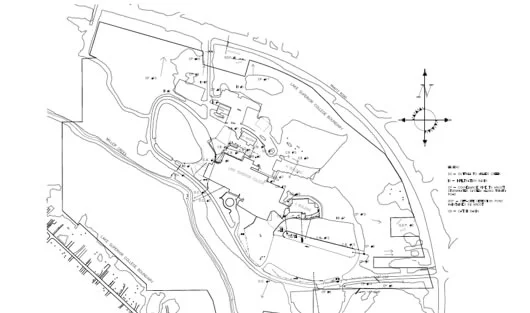
Receiving waters for Lake Superior College stormwater include a section of Miller Creek within the college’s property boundaries. Miller Creek is a designated Trout Stream. The boundaries are defined by the college campus property lines from Trinity Road to Miller Creek at 2101 Trinity Road, Duluth, MN 55804. LSC has five outfalls directly to Miller Creek and seven infiltration basins. See applicable maps in Appendix A and Appendix B.
Roles and Responsibilities
Responsible Official: Nickoel Anderson, Vice President of Finance and Administration
SWPPP Coordinator: Tammy Wilman, Occupational Safety and Environmental Coordinator,
Departments with Stormwater Responsibilities: Building Operations, Public Safety and Facilities
Best Management Practices (BMPs) and Minimum Control Measures (MCMs)
1. Public Education and Outreach
Each year, Lake Superior College partners with local area agencies and authorities to distribute messages about pollution prevention in stormwater through a collaborative group called the Regional Stormwater Protection Team (RSPT). Some of these messages include a direct focus on smart salting to reduce impacts of the use of chlorides as deicers, keeping leaf litter off the streets, and messages on picking up pet waste all to improve water quality.
More information on Public Education and Outreach >
In 2025, RSPT and Lake Superior College focused outreach efforts on native plant benefits, pet waste pickup, smart salting, and native lawn conversion. LSC held a few table top events where they promoted how to salt smartly and the importance of picking up pet wastes. Brochures, stickers, and dog waste bags were handed out. Other public educational outreach involved running many targeted public service announcements through local television stations and movie theater advertisements. Mow Less, Lounge More video was a big part of the PSA announcements this year along with the Unintentional Litterer PSA featuring the No Poop Fairy.
More information on these and other educational topics >
2. Public Participation and Involvement
Lake Superior College encourages student and public participation in an annual campus-wide cleanup focused on keeping litter out of Miller Creek, a designated trout stream. Students and staff also plant 300 native trees every year to assist in erosion control and water absorption in the areas around the creek. Participation activities are documented through event summaries, photographs, sign-in sheets when applicable, and records of public comments received.
Each calendar year, Lake Superior College will provide a minimum of one opportunity for the public to provide input on the adequacy of the SWPPP. LSC has opted to participate in an online form that is left open from December 10 through December 31, 2025 to allow the public to comment on the SWPPP or any other portion of their stormwater program.
Lake Superior College’s SWPPP >
Lake Superior College welcomes any comments or questions about SWPPP at any events or contacting Tammy Wilman at or .
3. Illicit Discharge Detection and Elimination (IDDE)
Illicit discharge is the discharge of pollutants into Lake Superior College’s section of Miller Creek. LSC conducts visual inspections at the creek in an effort to detect and eliminate any signs or sources of pollution. Facilities and maintenance staff receive informal training to recognize and report potential illicit discharges, and all reported incidents are documented and tracked until resolution. To report concerns, contact Mark Cardinal at . Lake Superior College will investigate, address, and properly document these events. If the event is a spill or leak as described in Minn. Stat. 115-061, the Minnesota department of Public Safety Duty Officer may need to be called at 1-800-422-0798.
4. Construction Site Stormwater Runoff Control
Lake Superior College requires any construction site activities to comply with all City, County, and State regulations in relation to stormwater runoff. Lake Superior College relies on the City of Duluth’s construction stormwater inspection and enforcement authority to meet MS4 permit requirements for construction site stormwater runoff control. The City of Duluth requires an Erosion Control Permit for all construction activities that disturb more than 3,000 sq.f. or is within a shoreland zone. In 2025, LSC wrapped up the T-building expansion project on site and the contractor did pull an erosion control permit. The City conducts regular inspections of construction sites within its jurisdiction. All construction site stormwater concerns can contact City of Duluth Engineering at .
5. Post-Construction Stormwater Management
Lake Superior College requires any construction site activities to comply with all City, County, and State regulations, including MPCA Construction Stormwater activities Permit. In 2025, Lake Superior College completed the T-building expansion project resulting in a larger catch basin. Lake Superior College works with the City of Duluth to conduct plan reviews and approves the stormwater management plan for all projects prior to construction. The City of Duluth requires the installation of structural stormwater management practices that provide rate, volume, temperature and water quality controls for stormwater runoff from the proposed development. Permanent stormwater best management practices are inspected and maintained by LSC Maintenance staff in coordination with the City of Duluth as applicable. Maintenance activities and inspections are documented to ensure continued performance of stormwater controls.
6. Pollution Prevention / Good Housekeeping
Lake Superior College practices pollution prevention through a variety of efforts. Facilities and Maintenance staff are trained on smart salting annually and receive a smart salting certification through the MPCA every 5 years. These trainings stress the importance of protecting water quality and minimize the use of deicers. LSC uses sand with some salt on the roadways and uses cherry stone on the walkways when needed. LSC also has heated sidewalks to minimize the use of grit or salt products. Sidewalks and parking lots are swept annually at a minimum. Storage of sand and salt meets the requirements to prevent runoff into storm drains. Catch basins are to be cleaned out every 5 years.
Training records, inspection reports, and maintenance activities related to pollution prevention and good housekeeping are documented and retained in accordance with MS4 permit requirements.
SWPPP Evaluation and Updates
SWPPP will be evaluated and updated yearly. Changes for 2025 include staff title changes, department name updates, and revisions related to construction permitting requirements.
Measurable goals for each minimum control measure include implementing described activities annually, documenting participation, training, inspections, and maintaining records to evaluate program effectiveness.
Records related to MS4 activities, including inspections, maintenance, training, public outreach, construction coordination, and SWPPP evaluations, are retained in accordance with MPCA MS4 permit requirements and made available upon request.
Appendices
Appendix A – Boundary Map

Appendix B – Outfall Map